
Native California Lilacs (Ceanothus)
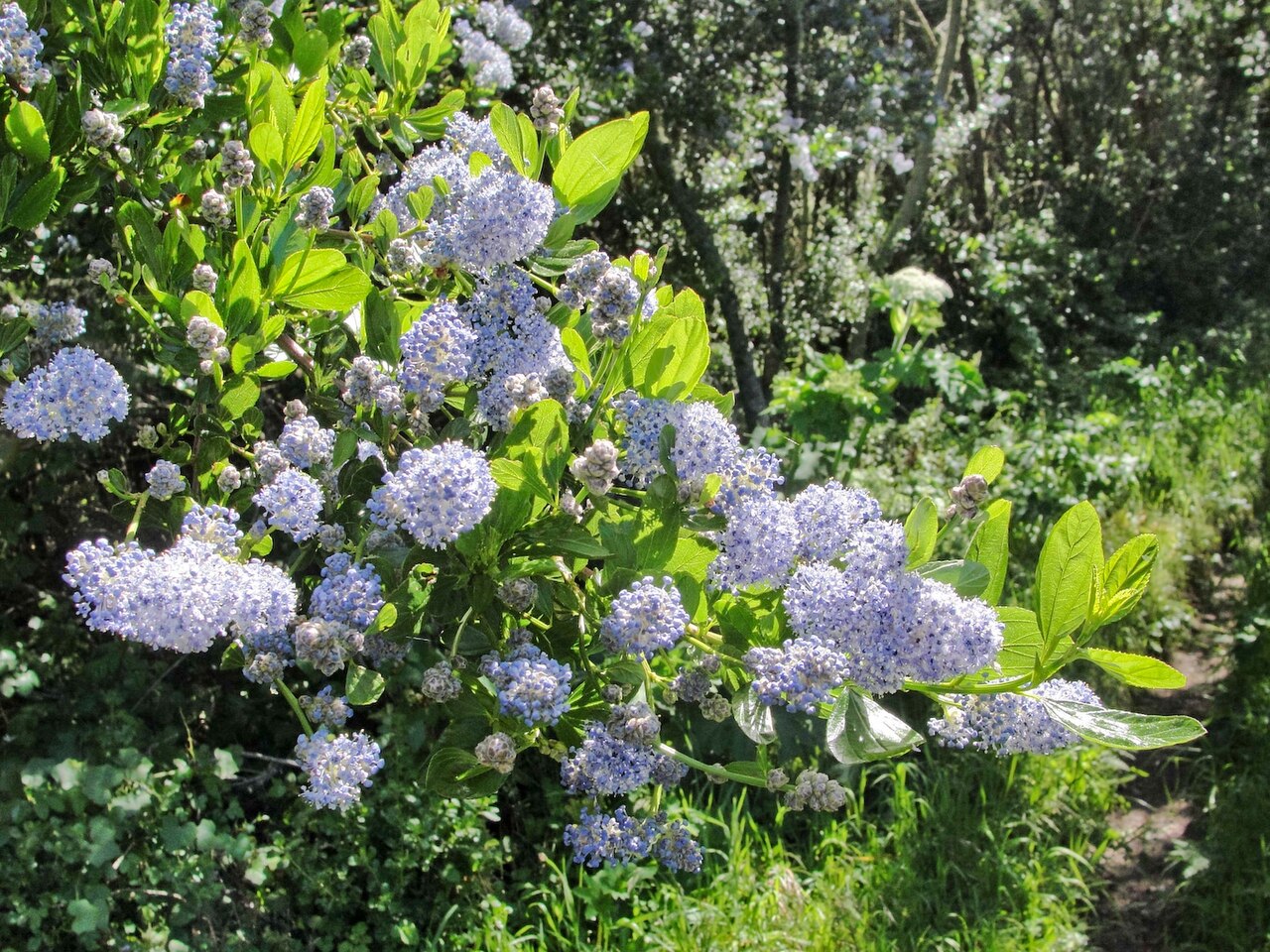
In April, whole hillsides in coastal California turn blue. The color comes from California lilacs, shrubs in the genus Ceanothus, whose dense clusters of tiny flowers range from white through powder blue to deep indigo. They are not lilacs at all. True lilacs (Syringa) are Eurasian members of the olive family; ceanothus belong to the buckthorn family (Rhamnaceae) and are entirely American. The nickname comes from the fragrant, lilac-like flower clusters, and the plants are also sold simply as “ceanothus” or “wild lilac.”
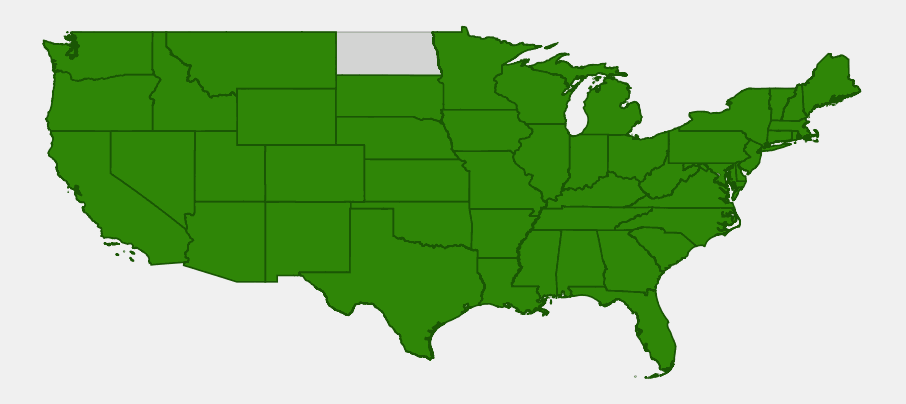
Ceanothus has roughly 50 to 60 species, all native to North America and nearly all to the United States and Mexico. California is the center of the genus, with more than 40 species and many more named varieties, from prostrate coastal mats to small trees. But the genus is not only Californian. Snowbrush, deerbrush, mountain whitethorn and pinemat range through the mountains of the West; Fendler’s ceanothus and desert ceanothus grow in the Southwest; and two species, New Jersey tea and inland ceanothus, are white-flowered prairie and woodland shrubs of the Midwest and East. Some native ceanothus grows in every state of the lower 48 except North Dakota.
This guide covers the most important US-native species, how to grow them, and how to tell native ceanothus from the hybrid cultivars and unrelated “lilacs” sold in nurseries. If you came here from a list of California flowering shrubs, note that most species want full sun and dry summers, not shade. If you came from an Oregon pollinator list, the natives of your state include snowbrush, deerbrush, buckbrush, blueblossom (southwestern Oregon), mahala mat and redstem ceanothus.
Identification
Ceanothus are woody shrubs or small trees. Botanists divide the genus into two groups that are easy to tell apart in the field, and knowing which group you are looking at narrows the possibilities quickly.
Bark & Stems
Twigs are often green, gray-green or reddish, and in several species (whitethorns, greenbark, Fendler’s ceanothus) the side branches end in stiff spines. Chaparral whitethorn has chalky white bark, greenbark ceanothus has smooth green bark even on older stems, and wart-stemmed ceanothus has stems studded with corky bumps. The eastern species, New Jersey tea and inland ceanothus, die back partly in winter and resprout from a massive, deep red root, the source of the old name “redroot.”
Leaves
The first group (subgenus Ceanothus) has alternate leaves, thin stipules that soon fall, and often three prominent veins running from the leaf base. Blueblossom, Carmel ceanothus, island ceanothus, deerbrush, snowbrush, New Jersey tea and the whitethorns are in this group. The second group (subgenus Cerastes) has opposite leaves, usually small, thick and leathery, with corky, persistent stipules at each leaf base that look like little warts. Buckbrush, hoaryleaf, bigpod, wart-stemmed, Point Reyes ceanothus and pinemat belong here. Leaves in many species are glossy dark green above; some, like wartleaf ceanothus, are covered with tiny glandular bumps, and snowbrush leaves are varnished, sticky and smell of cinnamon on warm days.
Flowers
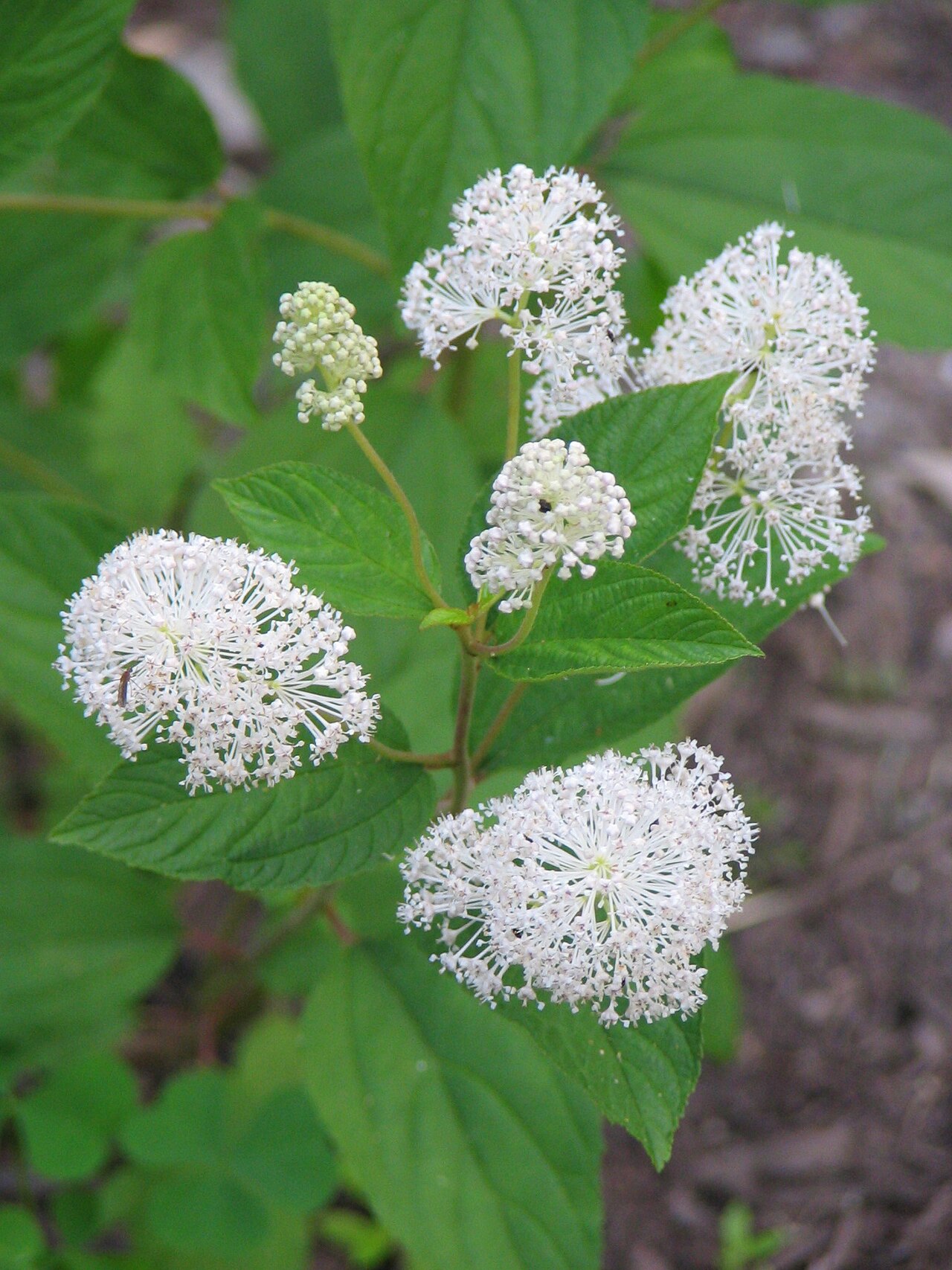
Individual flowers are tiny, about a quarter inch across, with five hooded petals on slender stalks, but they come in dense clusters (panicles or umbels) by the hundreds. Colors run from white (New Jersey tea, snowbrush, buckbrush, bigpod) through pale blue and lavender (deerbrush, chaparral whitethorn) to the deep blues of Carmel, wartleaf and blueblossom. Most species bloom between February and June, the coastal ones earliest. The flowers have a sweet, honey-like scent, and when rubbed with water they foam into a mild lather.
Fruit & Seeds
The fruit is a small, three-lobed capsule that dries and explodes in summer, flinging the seeds several feet. In the Cerastes group each capsule carries little horns. The seeds have hard coats and can lie in the soil for decades or longer; in many species they germinate in quantity only after a fire cracks the seed coat.
Quick Facts
| Scientific Name | Ceanothus L. (genus) |
| Family | Rhamnaceae (Buckthorn) |
| US-Native Species | Roughly 50 (approximate); more than 40 in California |
| Growth Forms | Prostrate mats, rounded shrubs and small trees; evergreen in the West, deciduous or semi-woody in the East |
| Mature Height | Under 1 ft (pinemat, Point Reyes ceanothus) to about 25 ft (island ceanothus); most 3–10 ft |
| Growth Rate | Fast |
| Sun Exposure | Full Sun; light afternoon shade in hot inland areas |
| Water Needs | Low; most western species want dry summers once established |
| Soil Type | Well-drained sand, gravel, rocky or decomposed granite soils; many tolerate clay on slopes |
| Bloom Time | February–June for most species; New Jersey tea late spring to early summer |
| Flower Color | White, pale blue, lavender or deep blue |
| Fruit | Small three-lobed capsules that split explosively in summer |
| Wildlife Value | Very high: bees, butterflies and hummingbirds visit flowers; caterpillar host for several butterflies and moths; seeds for quail; browse for deer |
| Deer Resistant | No; deerbrush, buckbrush and New Jersey tea are favorite deer foods |
| USDA Hardiness Zones | About 3–10 across the genus; most California species 7–10 |
Native Range
California is the heart of the genus. Ceanothus is a dominant shrub of chaparral from the Oregon border to Baja California, and the state’s coast, Channel Islands and Coast Ranges are home to dozens of species found nowhere else, several of them rare and confined to a single county or island. Blueblossom, Carmel and Point Reyes ceanothus grow within sight of the ocean; buckbrush, hoaryleaf, bigpod and chaparral whitethorn cover dry foothill slopes; and deerbrush, mountain whitethorn and pinemat grow in the conifer forests of the Sierra Nevada and Cascades.
From there the genus reaches north and east. Snowbrush, deerbrush, redstem ceanothus and buckbrush grow in Oregon and Washington, and snowbrush ranges through the Rockies of Idaho, Montana, Wyoming, Utah and Colorado and into the Black Hills of South Dakota. Fendler’s ceanothus is a low spiny shrub of ponderosa pine forests in Arizona, New Mexico, Colorado, Utah and western Texas, and desert ceanothus (C. greggii) grows on dry slopes from Texas to California. On the Great Plains, inland ceanothus (C. herbaceus) grows on prairies and rocky hills from South Dakota and Nebraska south to Texas and east to the Great Lakes.
East of the Mississippi, New Jersey tea grows in dry, open oak woods, barrens and prairies from Maine and Minnesota to Florida and eastern Texas, and a small relative, littleleaf ceanothus, grows in sandhills of the southeastern coastal plain. North Dakota is the only state in the lower 48 with no native ceanothus. Alaska and Hawaii have none either. The colorful blue cultivars sold across the country, and planted in Europe, are mostly selections or hybrids of California species and are not native outside the Pacific Coast.
📋 Regional plant lists covering native ceanothus country: California & Nevada · Western Oregon & Washington · Idaho, Eastern Oregon & Eastern Washington · Montana & Wyoming · Utah & Western Colorado · Arizona & New Mexico · South & West Texas · Nebraska, Kansas & Eastern Colorado · Illinois, Iowa & Missouri · Michigan, Wisconsin & Eastern Minnesota · Ohio & Indiana · New York, Pennsylvania & Northern New Jersey · New Hampshire, Maine & Vermont · Maryland, Virginia & West Virginia · North Carolina & South Carolina · Georgia, Alabama & Mississippi · Arkansas, Louisiana, Eastern Oklahoma & Eastern Texas
Native Species
These are the US-native ceanothus most often grown in gardens or met in the wild, grouped by region. Follow the links for full growing profiles.
Coastal California Species
Blueblossom (Ceanothus thyrsiflorus): Native along the coast from southwestern Oregon to Santa Barbara County, often at forest edges and on fog-bathed slopes. A fast-growing shrub, usually 6 to 20 feet, with glossy, three-veined leaves and large plumes of pale to deep blue flowers in spring. One of the hardiest and most garden-tolerant species; ‘Skylark’ and ‘Snow Flurry’ are well-known selections.
Carmel Ceanothus (Ceanothus griseus): A coastal species of the Monterey Bay area, closely related to blueblossom, with dark, glossy leaves and bright blue flowers. Its low, spreading forms are the source of popular ground-cover cultivars such as ‘Yankee Point’ and ‘Diamond Heights’.
Point Reyes Ceanothus (Ceanothus gloriosus): A low, mat-forming shrub of windswept coastal bluffs and sandy flats in Marin, Sonoma and Mendocino counties, with stiff, holly-like, toothed leaves and deep blue flowers. Excellent for banks and seaside gardens; ‘Anchor Bay’ is a common selection.
Island Ceanothus (Ceanothus arboreus): Also called feltleaf ceanothus. Native only to the Channel Islands off southern California. The largest ceanothus, a small tree to about 25 feet with broad leaves felted beneath and pale blue flower clusters in late winter and spring. It is one parent of the hybrid ‘Ray Hartman’.
Bigpod Ceanothus (Ceanothus megacarpus): A dominant shrub of coastal chaparral from Santa Barbara County to the Santa Monica Mountains and the Channel Islands, 6 to 12 feet tall, with small opposite leaves, white flowers in winter and unusually large seed capsules. It regenerates from seed after fire rather than resprouting.
Greenbark Ceanothus (Ceanothus spinosus): Also called redheart. A tall shrub or small tree of southern California coastal slopes, recognized by its smooth, olive-green bark and pale blue to nearly white flowers. Unlike many chaparral species, it resprouts strongly after fire.
Chaparral and Foothill Species
Buckbrush (Ceanothus cuneatus): Also called wedgeleaf ceanothus. The most widespread ceanothus of California, found in chaparral and foothill woodland from southern Oregon to Baja California. A stiff, gray-branched shrub 3 to 10 feet tall with small, wedge-shaped opposite leaves and white to pale lavender flowers. Extremely drought tolerant and a key browse plant for deer.
Chaparral Whitethorn (Ceanothus leucodermis): A spiny, rounded shrub of dry foothills from central California into Baja California, with pale, chalky white bark, blue-gray leaves and pale blue to white flowers. Its thorns make it a good barrier planting on dry slopes.
Deerbrush (Ceanothus integerrimus): A loose, open shrub 3 to 12 feet tall of foothill and mountain forests from Washington through Oregon and California, with outlying populations in Arizona and New Mexico. Its thin, light green leaves and fragrant white to pale blue flowers appear in late spring and early summer. As the name says, it is one of the most important deer browse plants in the West.
Mountain and Interior West Species
Snowbrush Ceanothus (Ceanothus velutinus): Also called tobacco brush or sticky laurel. A rounded evergreen shrub 3 to 10 feet tall of mountain slopes and burns from British Columbia to California and east through the Rockies to Colorado and the Black Hills. Its glossy, varnished, three-veined leaves smell of cinnamon, and its white flower clusters bloom in early summer. Seeds can wait in the soil for generations until a fire triggers them.
Mountain Whitethorn (Ceanothus cordulatus): A low, flat-topped, spiny shrub 2 to 5 feet tall with gray-green leaves and white flowers, common in open conifer forest and old burns of the Sierra Nevada, southern Cascades and the mountains of southern California and western Nevada.
Pinemat (Ceanothus prostratus): Also called mahala mat or squaw carpet. A prostrate evergreen mat a few inches tall with small, holly-like leaves and blue to lavender flowers, carpeting the ground under pines in the Sierra Nevada and Cascades from California to Washington and western Nevada. Needs cold winters and sharp drainage; difficult in lowland gardens.
Fendler’s Ceanothus (Ceanothus fendleri): A low, spiny, gray-green shrub 1 to 3 feet tall with small white flower clusters, native to ponderosa pine and pinyon-juniper country in Arizona, New Mexico, Colorado, Utah and western Texas. One of the few ceanothus suited to the high, dry Southwest.
Prairie and Eastern Species
New Jersey Tea (Ceanothus americanus): The ceanothus of the East and Midwest, native from Maine and southern Quebec to Florida and west to Minnesota, Nebraska and eastern Texas, in dry, open woods, prairies and barrens. A compact, deciduous shrub 2 to 3 feet tall with toothed, prominently veined leaves and rounded clusters of white flowers in late spring and early summer. Its deep red root makes it extremely drought tolerant once established, but hard to transplant.
Inland Ceanothus (Ceanothus herbaceus): Also called prairie redroot or Jersey tea. A Great Plains and Midwest species from South Dakota and Nebraska south to Texas and east to Michigan and Illinois, on rocky prairies, bluffs and sand. Similar to New Jersey tea but smaller, with narrower, shinier leaves and flower clusters at the tips of the new shoots.
More native Ceanothus profiles: Hoaryleaf Ceanothus (C. crassifolius), southern California chaparral · Wart-Stemmed Ceanothus (C. verrucosus), coastal San Diego County · Wartleaf Ceanothus (C. papillosus), California Coast Ranges · Cupped Leaf Ceanothus (C. greggii), deserts from Texas to California
Other native species without their own profile yet include redstem ceanothus (C. sanguineus), a deciduous white-flowered shrub of Oregon, Washington, Idaho and Montana; Santa Barbara ceanothus (C. impressus), a deep blue coastal species and parent of several hybrids; and littleleaf ceanothus (C. microphyllus), a small shrub of southeastern coastal-plain sandhills.
Non-Native Look-Alikes
Ceanothus is a North American genus, so the confusion here is less about foreign species in the genus and more about hybrids and about unrelated shrubs that share the name “lilac.”
Hybrid Cultivars
Many of the best-selling ceanothus are garden hybrids between California species. They are North American in parentage but are not wild plants anywhere:
- ‘Concha’: A dense shrub 6 to 7 feet tall with dark green leaves, reddish buds and deep cobalt-blue flowers. A hybrid of California species, and one of the most reliable ceanothus in gardens, tolerating heavier soil and occasional summer water better than most.
- ‘Ray Hartman’: A large shrub or small multi-trunked tree to about 15 to 20 feet, a cross of island ceanothus and Carmel ceanothus, with big medium-blue flower clusters. Often used as a small street or patio tree in California.
- ‘Dark Star’ and ‘Julia Phelps’: Compact shrubs with tiny leaves and intense dark blue flowers, with Santa Barbara ceanothus in their parentage.
- Ceanothus × delilianus (‘Gloire de Versailles’, ‘Henri Desfossé’): Deciduous hybrids made in 19th-century France between New Jersey tea and the Mexican C. coeruleus, with soft blue summer flowers. Common in European gardens; one parent is not native to the US.
These hybrids still feed bees and butterflies and are fine choices in Pacific Coast gardens. If you want plants adapted to your own area and fully native, choose a wild species from your region instead.
Unrelated “Lilacs” and Blue-Flowered Shrubs
- Common lilac (Syringa vulgaris): The true lilac, from southeastern Europe, in the olive family. Larger, heart-shaped leaves and bigger, individually visible four-lobed flowers. Not native anywhere in North America, though old plantings persist around farmsteads.
- Butterfly bush (Buddleja davidii): A Chinese shrub with long lilac-purple flower spikes. It seeds into riverbanks, roadsides and clearcuts in the Pacific Northwest and is listed as a noxious weed in Oregon and Washington. Oregon gardeners looking for a blue-flowered pollinator shrub should choose ceanothus instead.
- Chaste tree (Vitex agnus-castus): A Mediterranean shrub with lavender-blue flower spikes in summer, sometimes called “Texas lilac.” Not native, and it self-seeds in parts of the South.
- Rosemary and lavender: Mediterranean herbs often planted alongside ceanothus in dry gardens; their flowers are blue but their leaves are needle-like and aromatic.
Growing & Care Guide
Light
Nearly all ceanothus need full sun to flower well and keep a dense shape. In hot inland valleys, coastal species appreciate light afternoon shade, and blueblossom and deerbrush tolerate the edge of open woods, but in real shade every species gets leggy and blooms poorly. New Jersey tea and inland ceanothus grow in sun to light shade in oak openings.
Soil & Water
Drainage matters more than soil fertility. Plant western species on slopes, mounds or sandy, gravelly soil. Once established, usually after one or two summers, most California species should get little or no summer water. Regular irrigation in warm soil invites root rot and shortens their lives; this is the most common reason garden ceanothus die suddenly. Coastal species grown inland may need an occasional deep soak in midsummer, and ‘Concha’, blueblossom and Carmel ceanothus are the most forgiving of clay. New Jersey tea grows in sandy, rocky or loamy soil and is very drought tolerant thanks to its deep root.
Planting Tips
Plant in fall in mild-winter areas, so winter rains can establish roots, and in spring in cold-winter areas. Start with small plants; ceanothus resent root disturbance, and gallon-size plants usually catch up to larger ones within a year or two. Do not amend the planting hole with rich compost. Mulch with gravel or coarse wood chips, keeping mulch away from the crown. Ceanothus fix their own nitrogen, so they do not need fertilizer.
Pruning & Maintenance
Prune lightly, if at all, right after flowering, and tip-prune young plants to keep them bushy. Avoid cutting into large, old wood: most species do not resprout from bare stems. Expect many California ceanothus to live 10 to 20 years in gardens; they are fast-growing pioneer shrubs and are replaced naturally after fire. New Jersey tea can be cut back hard in late winter to renew it. Protect young eastern plants from rabbits and deer.
Propagation
Seed needs treatment: pour hot (near-boiling) water over the seeds and let them soak overnight, then give them one to three months of cold, moist stratification. Seedlings vary because species hybridize freely in gardens. Named cultivars are propagated by semi-hardwood cuttings in summer and fall, which root well with rooting hormone and bottom heat.
Landscape Uses
- Flowering hedges and screens with blueblossom, ‘Ray Hartman’ or island ceanothus
- Bank and slope cover with Point Reyes ceanothus, Carmel ceanothus, California buckwheat and California fuchsia
- Dry chaparral gardens with manzanita, toyon, coffeeberry, Cleveland sage and black sage
- Pacific Northwest pollinator gardens with snowbrush or blueblossom, red-flowering currant, salal and kinnikinnik
- Prairie and meadow gardens in the East and Midwest with New Jersey tea, leadplant, butterfly weed, wild bergamot and little bluestem
- Fire-adapted restoration on burned or disturbed western slopes, where ceanothus improves soil nitrogen for the plants that follow
Wildlife & Ecological Value
For Pollinators
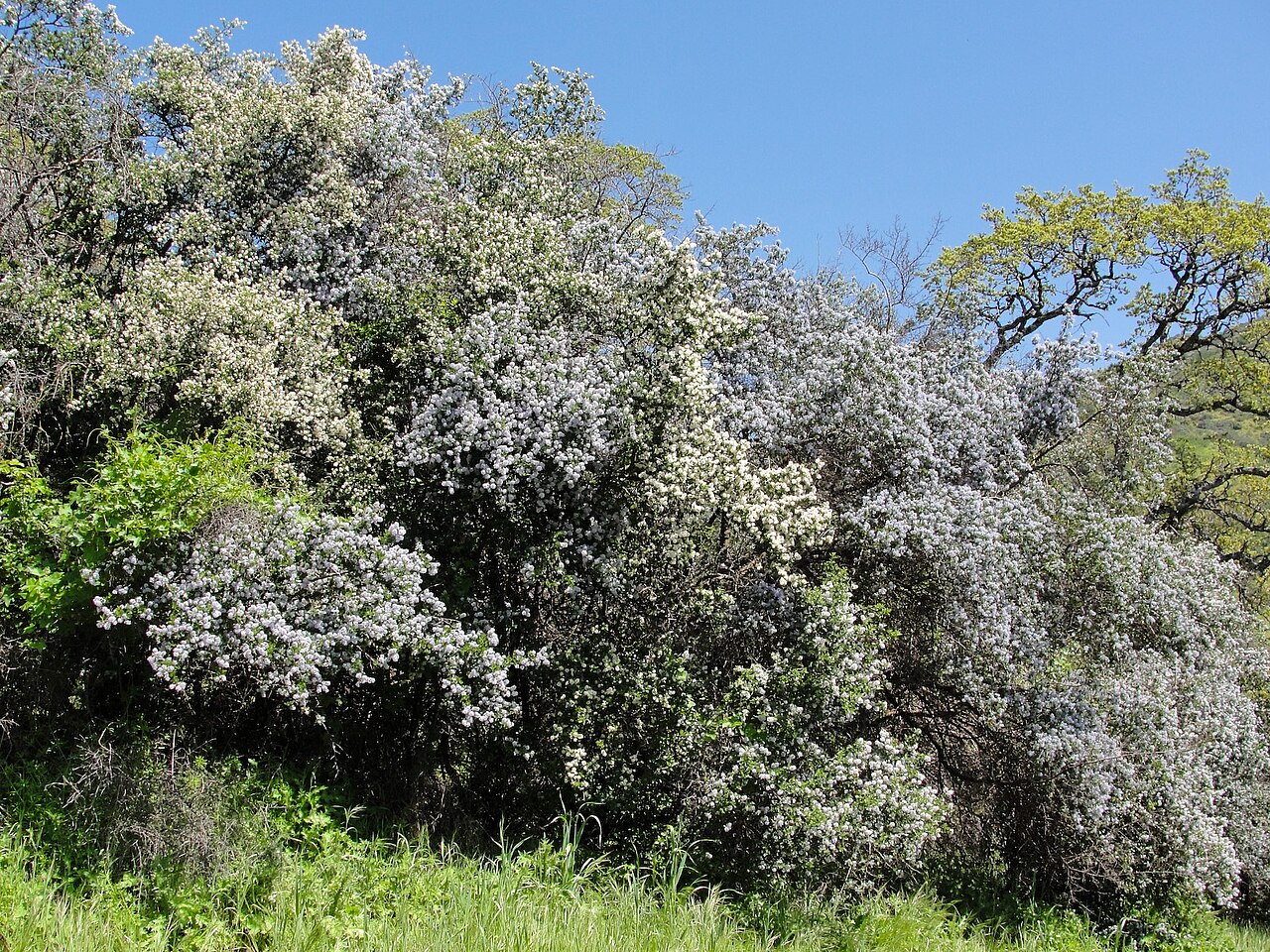
A ceanothus in full bloom hums. Honey bees, bumble bees, mason bees, mining bees and many other native bees work the flowers, along with flies, beetles and butterflies. Bloom comes early in the season in California, when queen bumble bees are building their first colonies. In the East, New Jersey tea is one of the best native shrubs for small bees, wasps and butterflies in early summer.
For Caterpillars
Ceanothus is a host plant for the ceanothus silkmoth, one of the West’s giant silk moths, and for the pale swallowtail, California tortoiseshell and echo azure. In the East, New Jersey tea hosts the mottled duskywing, a declining skipper, and the spring azure. These caterpillars rarely do noticeable damage.
For Birds
Hummingbirds visit the flowers for nectar and for the tiny insects they attract. California quail, other ground birds and small seed-eaters eat the seeds, and dense, spiny species such as the whitethorns give nesting cover to wrentits, towhees and sparrows.
For Mammals
Deerbrush, buckbrush, snowbrush and other species are among the most important browse plants for mule deer and black-tailed deer in the West. Elk browse them too. In the East, deer and rabbits browse New Jersey tea heavily, which is why young plants often need protection.
Ecosystem Role
Ceanothus roots carry nodules of Frankia, a soil bacterium that fixes nitrogen from the air, so the shrubs enrich poor, burned or rocky soils. Many western species are fire followers: their long-lived seeds germinate in great numbers after a fire, and the shrubs rebuild cover and soil fertility in the years before conifers and oaks return.
Cultural & Historical Uses
The flowers of many species contain saponins and lather when rubbed with water. Native peoples of California and the West used them as soap, and hikers still demonstrate it on spring trails. Tribes also used ceanothus stems for baskets, arrow shafts and digging tools, and snowbrush and other species were part of the plant knowledge of many western tribes.
New Jersey tea got its name during the American Revolution, when colonists boycotting British tea dried its leaves as a substitute. It contains no caffeine. The large red roots were used as a red dye.
Ceanothus became garden plants in Europe in the 1700s, when New Jersey tea was sent to England, and French nurseries later bred the deciduous C. × delilianus hybrids. California nurseries and botanic gardens such as Rancho Santa Ana and Santa Barbara selected and introduced most of the evergreen cultivars sold today, which is why “California lilac” is the name most gardeners know.
Frequently Asked Questions
Is California lilac a real lilac?
No. California lilacs are Ceanothus, in the buckthorn family, and all are native to North America. True lilacs (Syringa) are Eurasian shrubs in the olive family. The name comes from the fragrant, lilac-colored flower clusters.
Is ceanothus native to Oregon?
Yes. Oregon natives include snowbrush, deerbrush, buckbrush, redstem ceanothus, mahala mat and, in the southwest corner of the state, blueblossom. Many of the blue cultivars sold in Oregon nurseries are selections or hybrids of California species.
Can California lilac grow in shade?
Not well. Most species need full sun to flower and stay dense. Light afternoon shade is helpful in hot inland areas, but in real shade ceanothus become leggy and short-lived.
Why did my ceanothus suddenly die?
The usual cause is summer water. Most California species are adapted to dry summers, and regular irrigation in warm, heavy soil leads to root rot. Plant on a slope or in fast-draining soil and stop watering once the shrub is established. Garden ceanothus are also naturally short-lived, often 10 to 20 years.
Is there a native ceanothus for the eastern United States?
Yes. New Jersey tea (Ceanothus americanus) grows wild from Maine to Florida and west to Minnesota and Texas, and inland ceanothus grows on prairies of the Midwest and Great Plains. Both are small, white-flowered shrubs that are excellent for pollinators and dry, sunny sites.

Looking for a nursery that carries Native Ceanothus?
Browse our native plant nursery directory: Alabama, Arizona & Arkansas · California · Colorado, Connecticut, Delaware, Florida & Georgia · Idaho, Illinois, Indiana, Iowa & Kansas · Kentucky, Louisiana, Maine, Maryland, Massachusetts, Michigan, Minnesota, Mississippi, Missouri & Montana · Nebraska, Nevada, New Hampshire, New Jersey, New Mexico, New York, North Carolina, Ohio & Oklahoma · Oregon · Pennsylvania, Rhode Island, South Carolina, South Dakota, Tennessee, Texas, Utah, Vermont & Virginia · Washington · West Virginia, Wisconsin & Wyoming

