
Native Willows (Salix)
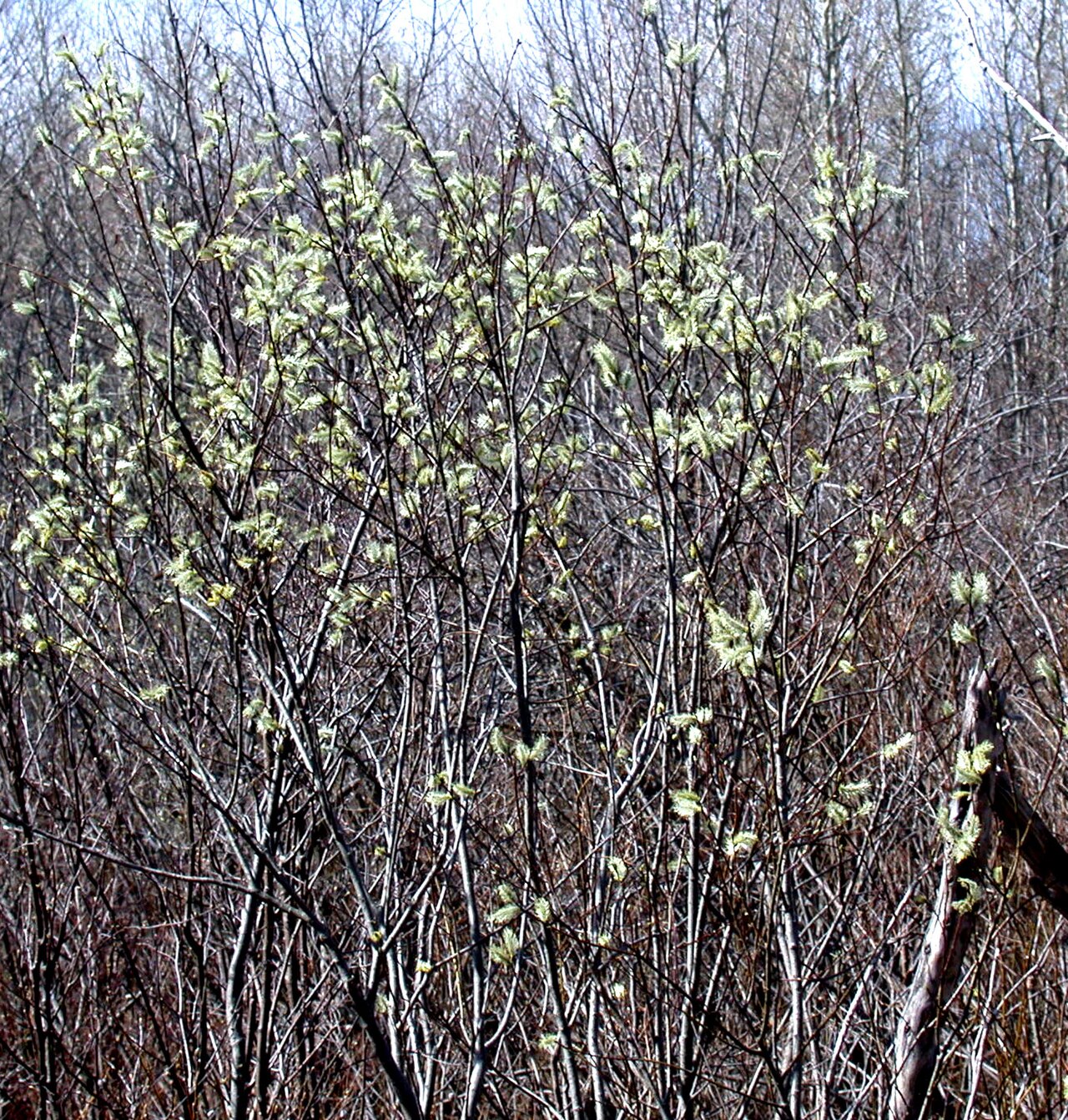
Willows are some of the most useful and least appreciated native plants in North America. The genus Salix has about 450 species worldwide, and roughly 100 of them are native to the United States They range from 60-foot black willows on Mississippi River bottomlands to pussy willows in Michigan wetlands and arctic willows only a few inches tall that creep across Alaska tundra and high western peaks.
Almost every native willow grows where water is close at hand: along streams, lakeshores, marshes, wet meadows, sandbars and dunes. They hold stream banks together, shade cold-water fish, feed beavers and moose, and host more species of caterpillars than almost any other plant group, which in turn feed nesting songbirds. Their catkins open in late winter and early spring, before most flowers, and provide the first big flush of pollen and nectar of the year for native bees and queen bumble bees.
The willow most people picture, the weeping willow, is not native to North America; it comes from China. Many other willows sold at garden centers, including white willow, dappled willow and most dwarf “creeping alpine” willows, are imported too. This guide covers the native willows, how to identify them, how to tell them apart from the imported species, and how to use them in gardens and restoration.
Identification
Willows are deciduous trees and shrubs. In winter and early spring the bare stems are often brightly colored, yellow, red, orange, olive or purple, and many species form multi-stemmed thickets. Identifying a willow to species can be hard even for botanists, because many species look alike and hybridize, but recognizing a willow as a willow is easy.
Leaves & Stems
Leaves are alternate and usually narrow, from the very slender, gray-green leaves of sandbar willows to the broader, elliptic leaves of pussy willow and Bebb willow. Many species have small leafy stipules at the base of the leaf stalk. The most reliable genus-level clue is the bud: each willow bud is covered by a single cap-like scale, unlike the overlapping scales of most other trees. Twigs are flexible and, in some species, snap easily at the base.
Flowers (Catkins)
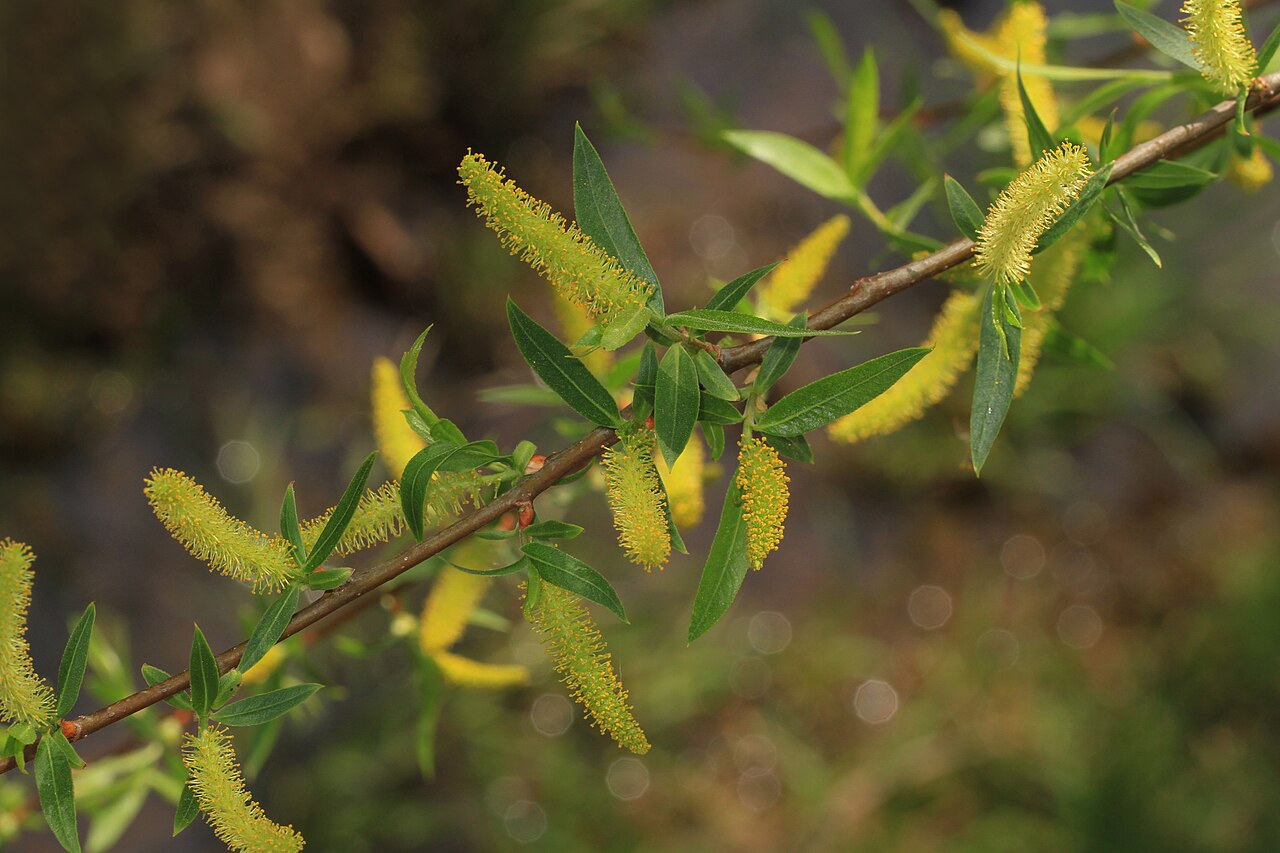
Willows have no petals. Their tiny flowers are packed into upright or arching catkins, and male and female catkins grow on separate plants. Male catkins are the familiar fuzzy “pussies” that turn yellow with pollen; female catkins are greener and less showy. Depending on the species, catkins open before the leaves, with the leaves or after them.
Fruit & Seeds
Female catkins ripen into clusters of small capsules that split to release tiny seeds attached to tufts of white, cottony hairs. The seeds blow and float away in late spring or early summer and stay alive for only a few days, so they must land on moist, bare mud or sand to germinate. That is why willows quickly colonize new sandbars and flood-scoured banks.
Quick Facts
| Scientific Name | Salix L. (genus) |
| Family | Salicaceae (Willow family) |
| US-Native Species | About 100 (approximately; about 450 worldwide) |
| Growth Forms | Trees, multi-stemmed shrubs and prostrate dwarf shrubs |
| Mature Height | A few inches (arctic and alpine creepers) to about 60 ft or more (black willow); most native willows are 6–20 ft shrubs |
| Sun Exposure | Full sun to light shade; few willows tolerate deep shade |
| Water Needs | High for most species; a few, such as Scouler’s and Bebb willow, tolerate drier upland sites |
| Soil Type | Moist to wet soils of almost any texture: mud, sand, gravel, loam |
| Bloom Time | Late winter to early summer, depending on species and elevation |
| Flower Color | Silvery-gray, yellow or green catkins |
| Wildlife Value | Very high: early pollen for bees, host to hundreds of caterpillar species, browse for beaver, moose, elk and deer, nesting cover for songbirds |
| Deer Resistant | No; deer, elk, moose and rabbits browse willows heavily |
| USDA Hardiness Zones | About 1–10 across the genus, varying by species |
Native Range
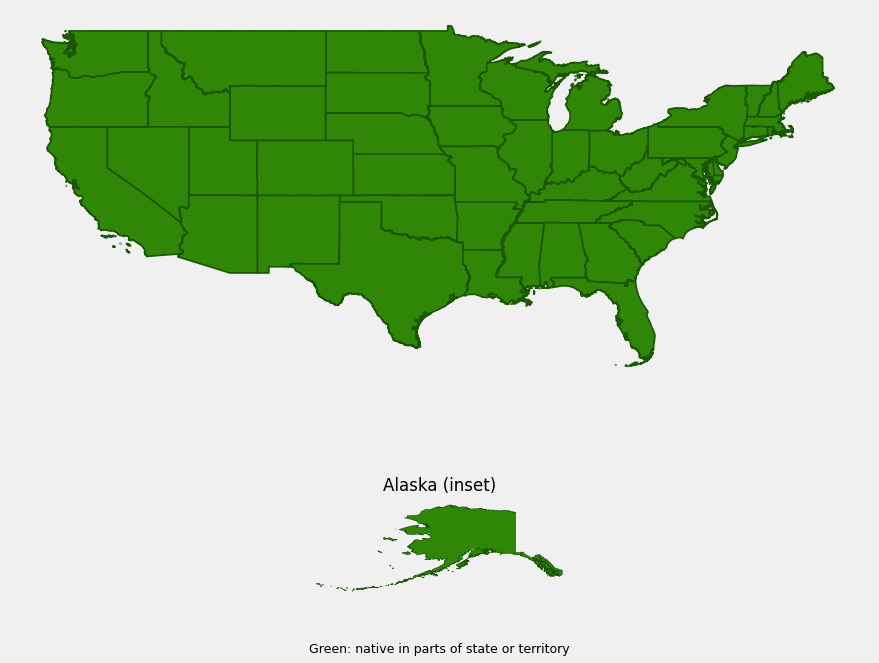
Native willows grow in all 48 contiguous states and Alaska; Hawaii has none. They are most diverse in the North and in the western mountains. Alaska has the greatest variety, with dozens of species from tall feltleaf willow along rivers to tiny arctic and net-leaf willows on the tundra. The Pacific Northwest, Rocky Mountains and Great Lakes states also have many species. Michigan, for example, has around two dozen native willows, mostly shrubs of wetlands, bogs and shorelines.
In the Southeast and the southern Plains, the choice narrows to a few lowland species such as black willow, coastal plain willow and sandbar willows. In the Southwest, willows follow rivers and springs through the desert: Goodding’s willow, red willow, arroyo willow and coyote willow are key species in cottonwood-willow gallery forests.
Weeping willow, white willow and crack willow have been planted across the country and grow wild in many places, especially along streams in the Northeast, Midwest and Pacific Northwest, but they are not native anywhere in North America.
📋 Regional plant lists with native willows: Michigan, Wisconsin & Eastern Minnesota · Western Oregon & Western Washington · Idaho, Eastern Oregon & Eastern Washington · Alaska · California & Nevada · Arizona & New Mexico · Utah & Western Colorado · Montana & Wyoming · North Dakota, South Dakota & Western Minnesota · Nebraska, Kansas & Eastern Colorado · South & West Texas · Arkansas, Louisiana, Eastern Oklahoma & Eastern Texas · Illinois, Iowa & Missouri · Ohio & Indiana · Kentucky & Tennessee · New York, Pennsylvania & Northern New Jersey · Delaware, Southern New Jersey & Long Island · Maryland, Virginia & West Virginia · North & South Carolina · Georgia, Alabama & Mississippi · Connecticut, Massachusetts & Rhode Island · New Hampshire, Maine & Vermont
Native Species
These 15 native willows are among the most common and most useful for gardens and restoration, and each links to our full profile. Every other willow profile on the site is listed at the end of this section.
Eastern & Midwestern Willows
Pussy willow (Salix discolor) is the native pussy willow of the Northeast, Great Lakes and northern Plains, a large shrub or small tree 6 to 20 feet tall with plump, silvery catkins in late winter. Its leaves are bright green above and whitish beneath. It grows in wet meadows, swamps and shorelines and is easy in any moist, sunny garden spot.
Black willow (Salix nigra) is the largest native willow in the East, a tree often 30 to 60 feet tall with dark, furrowed bark and narrow leaves that are green on both sides. It lines rivers, lakes and swamps from New England and the Great Lakes south to Florida and Texas.
Bebb willow (Salix bebbiana), or beaked willow, is a widespread shrub or small tree of the northern states and the West. It tolerates drier ground than most willows, and its stems sometimes develop diamond-shaped scars from fungal cankers, the source of carved “diamond willow” walking sticks.
Heartleaf willow (Salix eriocephala), also called Missouri River willow, is a 6- to 20-foot shrub of eastern and midwestern stream banks with reddish new leaves and leaf bases that are often rounded to slightly heart-shaped.
Shining willow (Salix lucida) is a shrub or small tree of northern wetlands and shores, named for its glossy, finely toothed leaves with long, tapering tips.
Silky willow (Salix sericea) is a 6- to 12-foot shrub of eastern stream banks and swamps whose narrow leaves have silky, silvery undersides.
Interior sandbar willow (Salix interior) spreads by root suckers into dense thickets on sandbars and riverbanks across the East and Midwest. Its very narrow leaves and colonizing habit make it a first-rate plant for stabilizing eroding banks.
Peachleaf willow (Salix amygdaloides) is a single- or few-trunked tree, usually 30 to 40 feet, of the Great Plains, Midwest and interior West, with peach-like leaves that are pale beneath.
Coastal plain willow (Salix caroliniana) is the common willow of southern swamps, springs and stream banks, a small tree with leaves that are whitish beneath, native from the Southeast west to Texas and north into the lower Midwest.
Western Willows
Sandbar or coyote willow (Salix exigua) is the thicket-forming, gray-leaved willow of western rivers and irrigation ditches. Like its eastern relative, it spreads by roots and is widely used to stabilize stream banks.
Pacific willow (Salix lasiandra) is a western tree willow, sometimes treated as a subspecies of shining willow, with long, glossy leaves and small glands at the top of the leaf stalk. It grows along rivers and lakes from Alaska and British Columbia to California and New Mexico.
Sitka willow (Salix sitchensis) grows along the Pacific coast from Alaska to California and inland to Idaho and Montana. The undersides of its leaves have a satiny sheen of fine hairs.
Hooker willow (Salix hookeriana), or dune willow, is a coastal shrub of dunes, estuaries and wet meadows from Alaska to northern California, with stout, woolly twigs and broad leaves.
Scouler’s willow (Salix scouleriana) is the West’s upland willow. It grows on dry slopes, forest openings and burned areas as well as stream banks, and its catkins open well before the leaves, making it one of the earliest bee plants in western forests.
Arroyo willow (Salix lasiolepis) is a shrub or small tree of streams, springs and seeps in California and across much of the Southwest, a key plant for hummingbird and songbird nesting habitat in dry country.
In the Pacific Northwest, native willows are also sold as named restoration selections of wild species, such as ‘Clatsop’ Hooker willow, ‘Nehalem’ Pacific willow, ‘Plumas’ Sitka willow and ‘Rogue’ arroyo willow. These are local native species chosen for streambank planting, not hybrids.
More willow profiles: Goodding’s willow (S. gooddingii) · red willow (S. laevigata) · Florida willow (S. floridana) · Bonpland willow (S. bonplandiana) · yewleaf willow (S. taxifolia) · balsam willow (S. pyrifolia) · feltleaf willow (S. alaxensis)
Native Dwarf & Creeping Willows
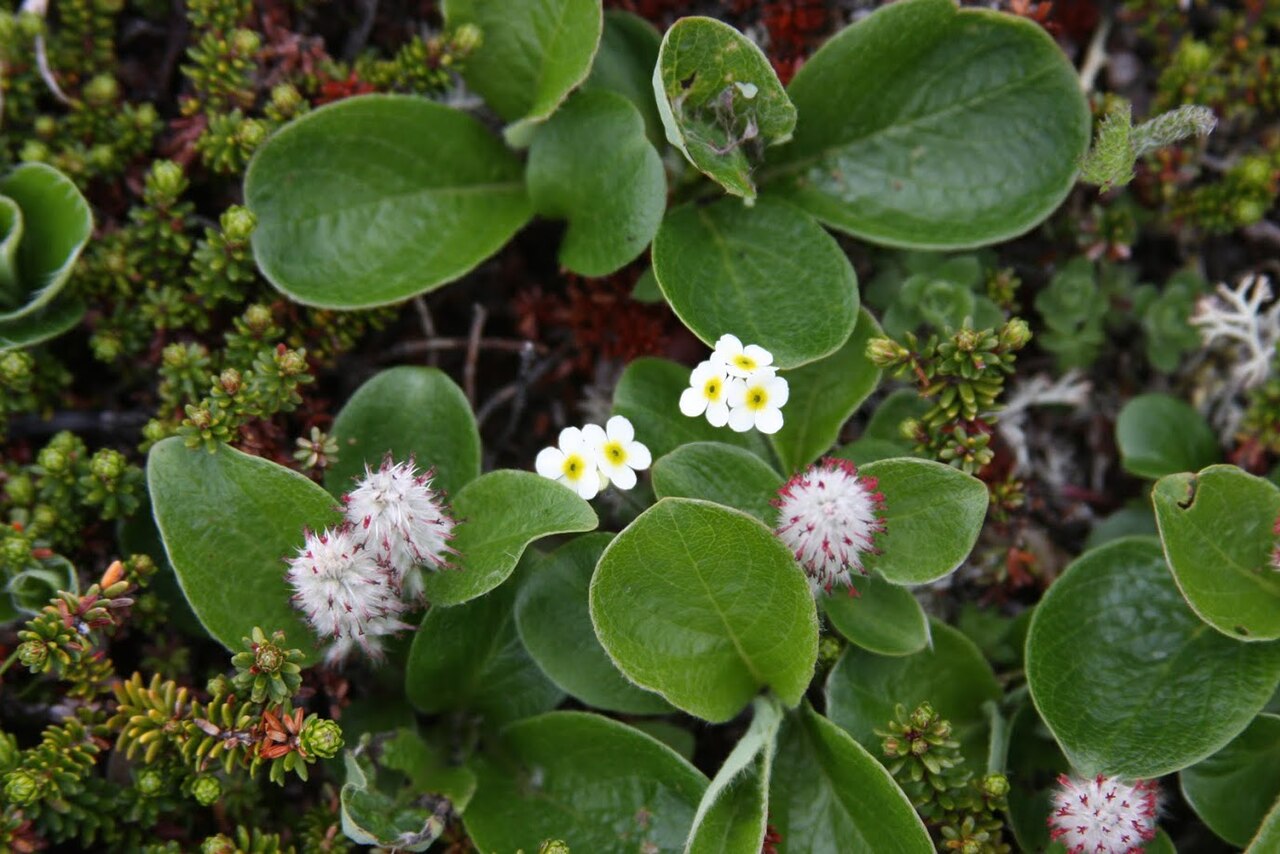
The low “creeping alpine willows” sold as ground covers are usually Japanese or European species (see below), but North America has its own. Arctic willow (Salix arctica) and net-leaf willow (Salix reticulata) hug the ground on Alaska tundra and high western peaks, and Cascade willow (Salix cascadensis) forms low mats in the alpine zone of the Cascades and Rockies. In the Northeast, bearberry willow (Salix uva-ursi) creeps over the alpine summits of New England and New York. These need cold, bright, well-drained conditions and are rarely sold outside specialist alpine nurseries.
Non-Native Look-Alikes
Weeping willow (Salix babylonica and hybrids). Native to China, with long, pendulous branches that sweep the ground. Most weeping willows planted in the US are hybrids of this species with white or crack willow. They are not native anywhere in North America, have brittle wood and aggressive, water-seeking roots, and should not be planted near sewer lines, septic fields or foundations. No native willow has a true weeping habit.
White willow (Salix alba). A large European and Asian tree with silvery-white leaf undersides, planted since colonial times and now naturalized along streams across much of the northern US. Golden willow (var. vitellina) is a yellow-twigged form.
Crack willow (Salix × fragilis). A European hybrid tree whose twigs snap off cleanly at the base, float downstream and root where they land. It has spread widely along streams and rivers in the northern US, where it forms thickets that compete with native willows, and it should not be planted near natural waterways.
Dappled willow (Salix integra ‘Hakuro Nishiki’). A Japanese shrub with pink-and-white variegated new leaves, very common in garden centers. Not native.
Imported creeping willows. Creeping willow (Salix repens) is European, and the “creeping alpine” or “Yezo dwarf” willow (Salix nakamurana var. yezoalpina) is Japanese. Both are sold as ground covers. For a native alternative in Washington or other western mountain areas, look for arctic, net-leaf or Cascade willow from an alpine specialist.
Goat willow and purple osier. Goat willow (Salix caprea), sold as “French pussy willow” and as the grafted ‘Kilmarnock’ weeping pussy willow, is European; its catkins are larger than native pussy willow’s. Purple osier (Salix purpurea), a European basket willow with purplish stems and often nearly opposite leaves, has naturalized in wet places in the Northeast and Midwest.
Growing & Care Guide
Light
Willows need full sun or very light shade. In shade they grow thin and leggy and are prone to disease.
Soil & Water
Most native willows want soil that stays moist to wet, and many tolerate seasonal flooding. They grow in clay, loam, sand or gravel. Scouler’s willow and Bebb willow are the best choices for drier ground. Willows are ideal for rain gardens, pond and stream edges, wet swales and low spots where other shrubs drown.
Planting Tips
Willows root so easily that you can often plant a cutting instead of a potted plant. In late winter or early spring, cut dormant stems 1/2 to 1 inch thick and 2 to 3 feet long from a local native willow, push them two-thirds of their length into moist soil, and most will root within weeks. Restoration crews use the same method (“live stakes”) to stabilize stream banks. Keep large tree willows well away from buildings, sewer lines, septic systems and drain tiles; their roots seek out water.
Pruning & Maintenance
Shrub willows respond well to hard pruning. Cutting a few of the oldest stems to the ground every year or two (coppicing) keeps them compact and produces the brightly colored young stems that look best in winter. Tree willows drop twigs and branches, so plant them where falling debris is not a problem. Expect insect feeding on the leaves; it is a sign the plant is doing its job feeding wildlife, and healthy willows recover quickly.
Propagation
Hardwood cuttings taken in the dormant season are the easiest method for nearly all native willows. Seeds are viable for only a few days, so sow them immediately on the surface of wet soil if you want to grow from seed.
Landscape Uses
- Stream bank, lakeshore and pond-edge stabilization
- Rain gardens and wet swales
- Early-spring pollinator and bird habitat
- Winter stem color and cut branches (pussy willow)
- Living fences, screens and windbreaks in wet ground
Wildlife & Ecological Value
For Pollinators
Willow catkins are among the earliest and richest sources of pollen and nectar each spring, which makes them critical for queen bumble bees building their first nests and for dozens of native mining bees (Andrena and related groups), some of which collect pollen only from willows. Bees visit both male and female catkins.
Butterflies & Moths
Willows are host plants for hundreds of species of butterflies and moths in the US, including the viceroy, mourning cloak, red-spotted purple, Compton tortoiseshell and western tiger swallowtail, as well as many sphinx and underwing moths. That caterpillar abundance makes willow thickets prime foraging for nesting songbirds.
Birds & Mammals
Willow flycatchers, yellow warblers, song sparrows and many other birds nest in willow thickets, and grouse and ptarmigan eat the buds in winter. Beavers depend heavily on willows for food and dam material, and moose, elk, deer and snowshoe hares browse them, often heavily.
Ecosystem Role
Willows are pioneers on fresh sandbars and flood-scoured banks. Their dense roots hold soil, their shade keeps streams cool for trout and salmon, and their fallen leaves feed stream insects. In much of the West, recovering willow thickets are a key sign of healthy streams.
Cultural & Historical Uses
Willow bark contains salicin, a compound the body converts to salicylic acid. Willow bark was used for pain and fever in Europe, Asia and North America for centuries, and 19th-century chemists’ work on salicylic acid led to aspirin. This is history, not advice: willow bark is not a safe substitute for medicine, and people who should not take aspirin should not take willow bark either.
Many Native American peoples used the flexible stems of native willows for baskets, fish traps, cradleboards, shelters and furniture, and willow basketry is still practiced today. Settlers used willow for wicker, charcoal and fencing.
Frequently Asked Questions
Is weeping willow native?
No. Weeping willow comes from China, and most weeping willows planted in the US are hybrids with European willows. No native willow weeps in the same way.
Which willows are native to Michigan?
Michigan has around two dozen native willows. Good garden and restoration choices include pussy willow, Bebb willow, heartleaf willow, shining willow, peachleaf willow, sandbar willow and black willow. All are deciduous and want sun and moist soil.
Which native willows are good for Oregon pollinator gardens?
Arroyo willow, Scouler’s willow, Sitka willow, Hooker willow and Pacific willow all bloom early and feed native bees. Scouler’s willow is the best choice for drier sites; the others need moist soil near water.
Is there a native creeping willow ground cover?
Yes, but it is a plant for alpine conditions. Arctic willow, net-leaf willow and Cascade willow creep over rock and tundra in Alaska and the western mountains. Most “creeping alpine willow” sold for gardens is a Japanese species.
Are willow roots a problem near houses?
Large tree willows have extensive roots that seek water and can invade sewer lines, septic fields and drain tiles. Plant tree willows well away from buildings and pipes, or choose shrub willows that you can keep small by pruning.

Looking for a nursery that carries Native Willows?
Browse our native plant nursery directory: Alabama, Alaska, Arizona & Arkansas · California · Colorado, Connecticut, Delaware, Florida & Georgia · Idaho, Illinois, Indiana, Iowa & Kansas · Kentucky, Louisiana, Maine, Maryland, Massachusetts, Michigan, Minnesota, Mississippi, Missouri & Montana · Nebraska, Nevada, New Hampshire, New Jersey, New Mexico, New York, North Carolina, North Dakota, Ohio & Oklahoma · Oregon · Pennsylvania, Rhode Island, South Carolina, South Dakota, Tennessee, Texas, Utah, Vermont & Virginia · Washington · West Virginia, Wisconsin & Wyoming

