
Native Hawthorns (Crataegus)
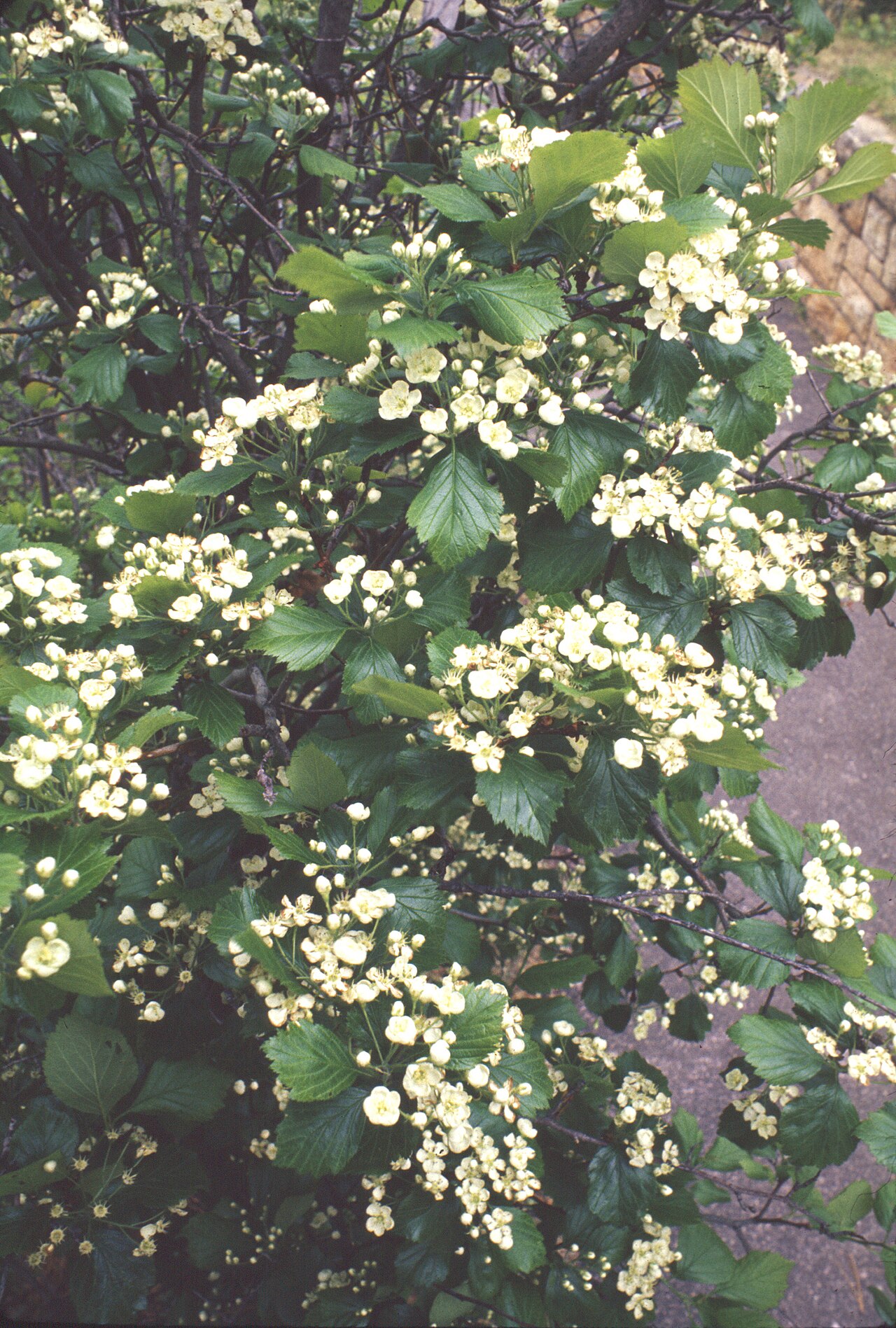
Hawthorns (Crataegus) are small, thorny trees and shrubs of the rose family, famous for their clouds of white spring flowers, their red, orange or black fruits called haws, and their stiff, sharp thorns. The genus is spread across the Northern Hemisphere, and many of the hawthorns sold in garden centers, such as English hawthorn and the double-red ‘Paul’s Scarlet’, come from Europe. But North America is the world center of hawthorn diversity: more than 100 species are native here, and every one of the lower 48 states has at least one.
Native hawthorns are some of the best small trees for wildlife in the country. Their flowers feed early-summer bees, their leaves host well over a hundred kinds of caterpillars, their thorny branches shelter nesting birds, and their fruit feeds birds and mammals well into winter. Several are also excellent ornamental trees: Washington hawthorn, cockspur hawthorn and green hawthorn (including the popular cultivar ‘Winter King’) are tough street and yard trees across much of the country.
This guide helps you sort out which hawthorns are native where you live, how to recognize the genus, how to grow it, and how to tell native species from the European hawthorns that are widely planted and, in the Pacific Northwest, invasive. When a planting list or article simply says “hawthorn,” choosing a native species from your own region is the best way to get all of the beauty with the most benefit for local wildlife.
Identification
Hawthorns are easy to recognize as a group and notoriously hard to identify to species. They hybridize freely, and many reproduce by seed without fertilization, producing local populations that look slightly different from one another. Botanists have described hundreds of names, and experts still disagree on how many species to recognize. For gardeners, the genus-level features below are what matter most.
Thorns & Bark
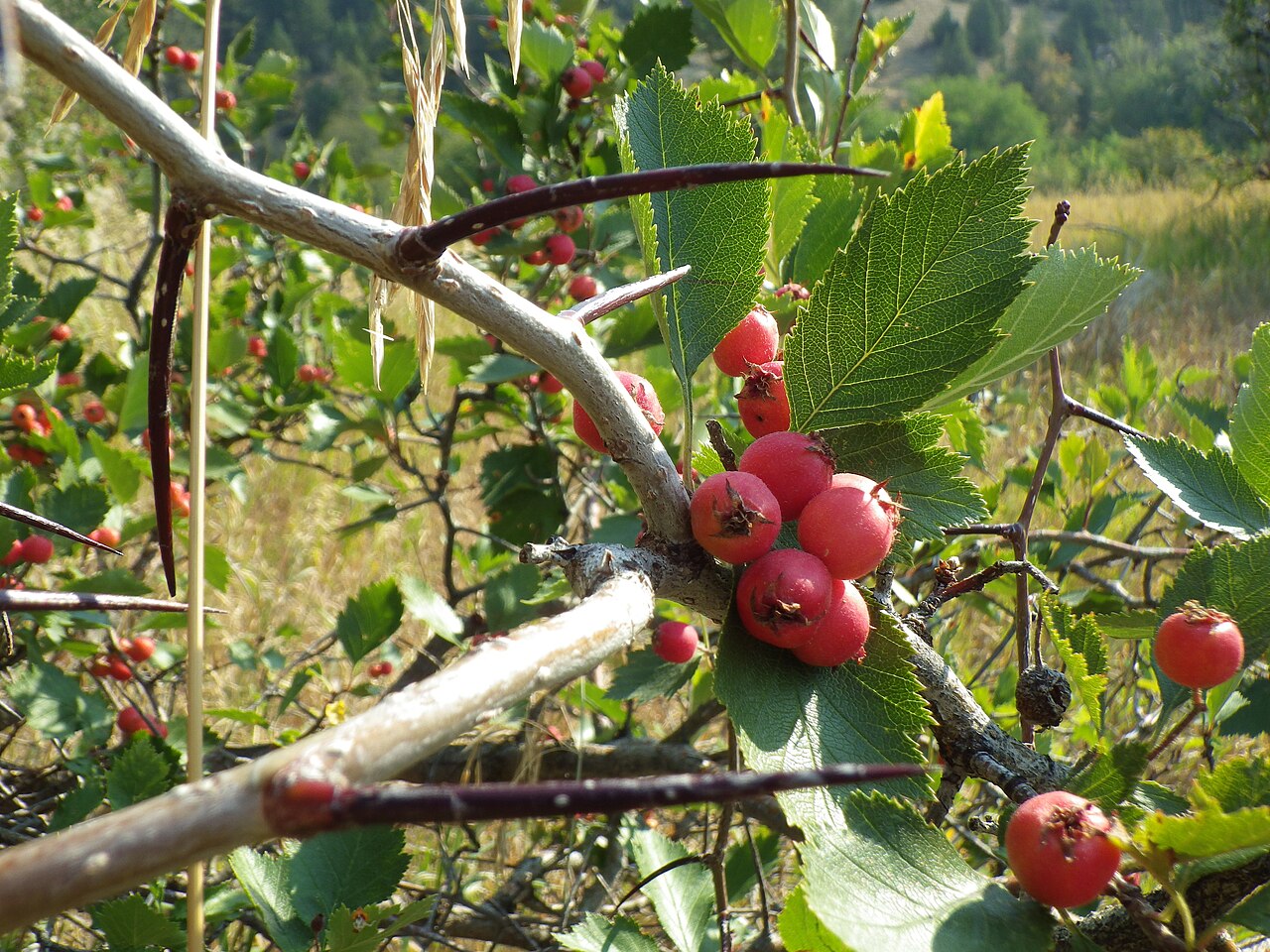
Most hawthorns carry stiff, sharp, unbranched thorns 1 to 4 inches long, which are modified short shoots that grow from the leaf axils. Cockspur and fireberry hawthorns have especially long thorns; green hawthorn and pear hawthorn have few or none. Young bark is smooth and gray; on older trunks it becomes scaly or flaky, sometimes peeling to show orange-brown patches, as in green and littlehip hawthorns. Many native species grow as multi-stemmed small trees with dense, wide, horizontally layered crowns.
Leaves
Hawthorn leaves are alternate and simple, with toothed edges, and on many species they are also shallowly to deeply lobed. Shapes range from the small, glossy, spoon-shaped leaves of cockspur hawthorn, to the broad, softly hairy leaves of downy hawthorn, to the deeply cut, parsley-like leaves of parsley hawthorn. Many species turn orange, red or purple in fall.
Flowers
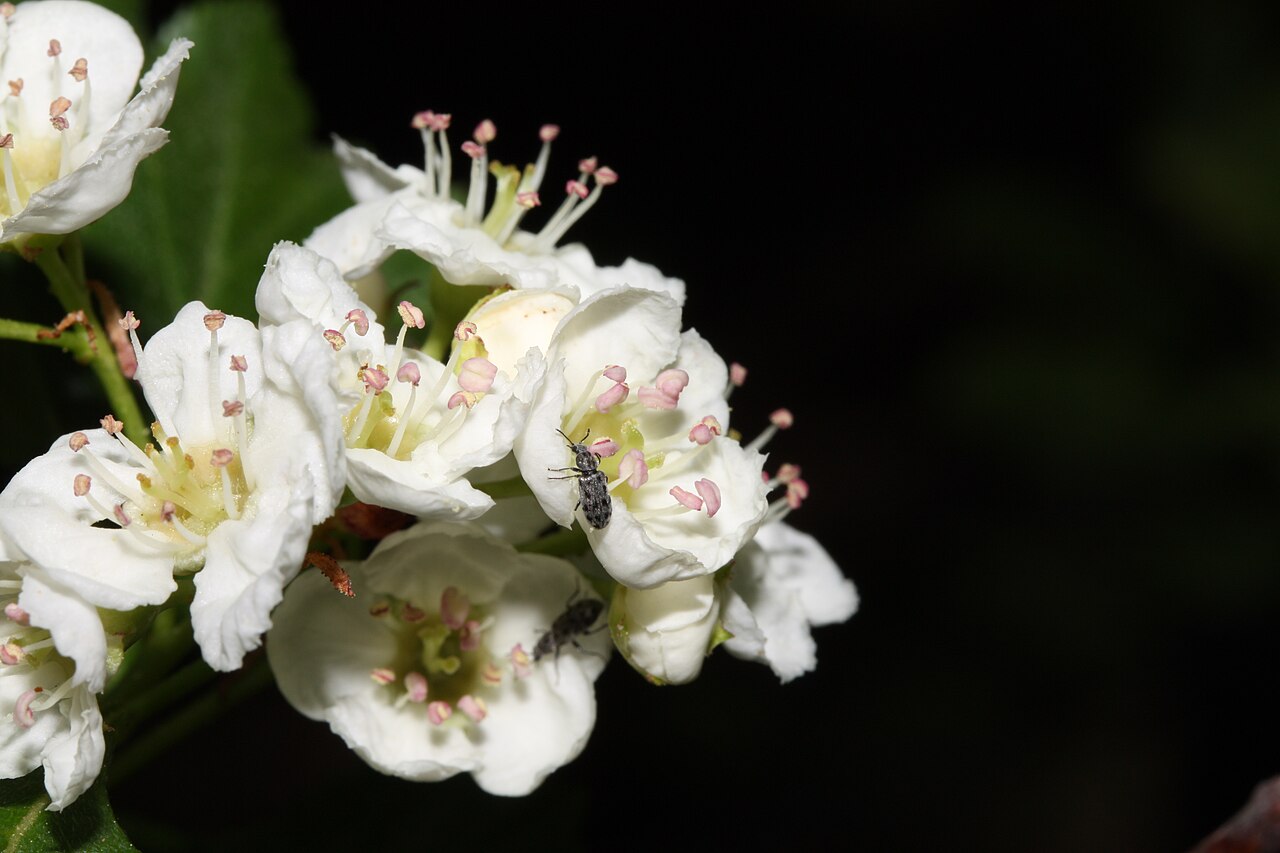
Hawthorns flower in mid to late spring, after the leaves emerge, in flat clusters of white (rarely pinkish) flowers about 1/2 to 1 inch across. Each has five round petals and a ring of 5 to 20 stamens whose anthers are pink, purple or cream, a detail botanists use to tell species apart. The flowers have a sweet but slightly musty scent that attracts flies and bees.
Fruit
The fruit, called a haw, is a small pome like a tiny apple, usually 1/4 to 3/4 inch across, containing one to five hard, bony seeds (nutlets). Most native species have red fruit, but some are orange, yellow or, in black hawthorn, purple-black. Fruit of some species, like Washington hawthorn, hangs on the tree well into winter.
Quick Facts
| Genus | Crataegus (hawthorns) |
| Family | Rosaceae (Rose) |
| US-Native Species | Roughly 100 or more (counts vary widely between experts) |
| Plant Types | Deciduous small trees and large shrubs; a few low shrubs |
| Mature Height | Mostly 15–30 ft; dwarf species 3–10 ft |
| Mature Spread | Often as wide as tall; 10–30 ft |
| Growth Rate | Slow to moderate |
| Sun Exposure | Full Sun to Part Shade |
| Water Needs | Average; many tolerate drought, and a few (mayhaws) grow in wet soil |
| Soil Type | Adaptable; clay, loam or sand with good drainage for most |
| Bloom Time | March – June (mayhaws earliest, Washington hawthorn latest) |
| Flower Color | White, occasionally pinkish |
| Fruit | Red, orange, yellow or black haws; late summer – winter |
| Fall Color | Orange, red or purple in many species |
| Wildlife Value | Very high: bees, 100+ caterpillar species, nesting birds, fruit eaters |
| USDA Hardiness Zones | 3–9 across the genus (species vary) |
Native Range
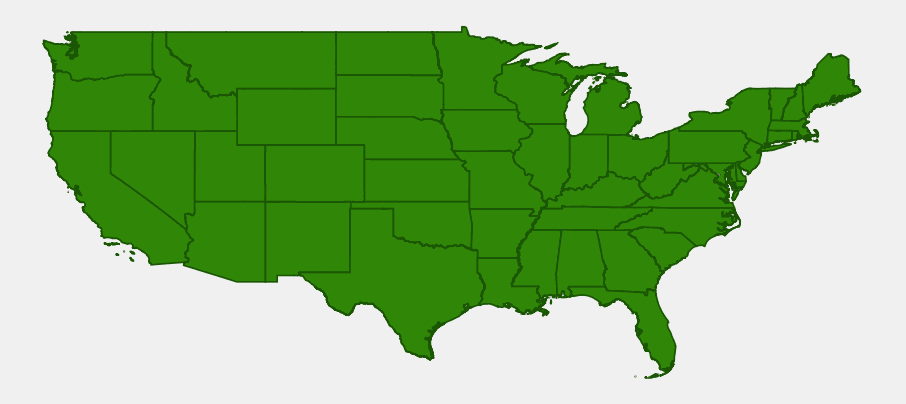
Native hawthorns grow in all of the lower 48 states but are richest by far in the East. The greatest number of species occurs from the Ozarks, the Ohio Valley and the southern Appalachians through the Southeast, and in the old fields, pastures and woodland edges of the Northeast and Great Lakes. Cockspur, dotted, downy, pear and scarlet hawthorns are among the widespread eastern and Midwestern species, while the Southeast adds parsley, green, littlehip, Washington and dwarf hawthorns and the wetland mayhaws.
Farther west, species become fewer but still important. Fleshy, fireberry and downy hawthorns reach the northern Great Plains; Texas and Oklahoma have a set of their own species, including Reverchon, Gregg and Tracy hawthorns. In the Rocky Mountains and Intermountain West, river hawthorn and black hawthorn line streams and canyons from Montana and Idaho to Colorado, Utah, Nevada, New Mexico and Arizona. Black hawthorn and its relatives also grow in the Pacific Northwest and northern California. Alaska and Hawaii have no native hawthorns.
Typical hawthorn habitats are open and sunny: forest edges, old fields and pastures, fencerows, stream terraces, rocky slopes and savannas. Hawthorns thrive where land is disturbed by grazing or fire and then left alone, which is why they are so common in abandoned pastures, where their thorns protect them from browsing cattle. The mayhaws are the exception, growing in seasonally flooded swamps and bottomlands of the Gulf and Atlantic coastal plains.
📋 Regional plant lists featuring Native Hawthorns: Georgia, Alabama & Mississippi · Arkansas, Louisiana, Eastern Oklahoma & Eastern Texas · Arizona & New Mexico · North Dakota, South Dakota & Western Minnesota · Delaware, Southern New Jersey & Long Island · Illinois, Iowa & Missouri · Idaho, Eastern Oregon & Eastern Washington · Ohio & Indiana · Kentucky & Tennessee · Maryland, Virginia & West Virginia · Michigan, Wisconsin & Eastern Minnesota · Montana & Wyoming · North Carolina & South Carolina · Nebraska, Kansas & Eastern Colorado · New Hampshire, Maine & Vermont · Connecticut, Massachusetts & Rhode Island · New York, Pennsylvania & Northern New Jersey · Western Oregon & Western Washington · Utah & Western Colorado · California & Nevada · South & West Texas
Native Species
These are the most widely grown and widespread native hawthorns, with notes on where they grow and what makes each useful in a garden.
- Washington Hawthorn (Crataegus phaenopyrum): Native mainly in the Southeast and lower Midwest, and widely planted far beyond. Small, glossy, maple-like lobed leaves, the latest flowers of any common hawthorn (early summer), excellent orange-red fall color and large clusters of small, shiny red fruit that last into winter. One of the best native street and yard trees; thorns are sharp.
- Cockspur Hawthorn (Crataegus crus-galli): Widespread in the eastern and central US. Glossy, spoon-shaped leaves, a wide, flat-topped crown and very long thorns up to 3 inches or more. Thornless forms (var. inermis) are sold for yards and streets.
- Green Hawthorn (Crataegus viridis): Native to bottomlands of the Southeast and lower Mississippi Valley. Few thorns, silvery-gray peeling bark and persistent red fruit. The cultivar ‘Winter King’ is one of the most popular hawthorns in American landscapes.
- Downy Hawthorn (Crataegus mollis): A Midwestern species with large, soft, downy leaves and large red fruit in late summer. Missouri’s state flower is the hawthorn blossom, and this is the species most often associated with it.
- Dotted Hawthorn (Crataegus punctata): Common in old fields of the Northeast, Great Lakes and Appalachians. Strongly horizontal branches and red or yellow fruit speckled with pale dots.
- Black Hawthorn / Douglas Hawthorn (Crataegus douglasii): The common native hawthorn of the Pacific Northwest and northern Rockies, with outlying populations around the upper Great Lakes. Short thorns and shiny purple-black fruit. Both of our profile pages describe this species.
- River Hawthorn (Crataegus rivularis): A thicket-forming shrub or small tree of streams and canyons in the Intermountain West and southern Rockies, including Utah, Colorado, Wyoming, Idaho, Nevada, New Mexico and Arizona. Dark purple to black fruit.
- Fireberry Hawthorn (Crataegus chrysocarpa): A northern shrub of the Great Plains, Great Lakes and northern Rockies, with long thorns and red fruit. Very cold hardy.
- Fleshy Hawthorn (Crataegus succulenta): A northern and Great Plains species with glossy leaves and juicy, bright red fruit; common in the Black Hills and across the upper Midwest. One of the hawthorns native to Colorado.
- Parsley Hawthorn (Crataegus marshallii): A small Southeastern tree with finely cut, parsley-like leaves, peeling bark and early white flowers with red anthers. A fine, delicate specimen for small yards.
- Mayhaw (Crataegus opaca) and May Hawthorn (C. aestivalis): Wetland hawthorns of Gulf and Atlantic coastal plain swamps and bottomlands, flowering very early and ripening their fruit in May. Mayhaw jelly is a Southern tradition.
- Dwarf Hawthorn (Crataegus uniflora): A low, 3- to 8-foot shrub of dry, sandy woods in the Southeast and mid-Atlantic, usually with single flowers and greenish-yellow to reddish fruit.
- Pear Hawthorn (Crataegus calpodendron): A nearly thornless eastern and Midwestern species with late, hairy flower clusters and small pear-shaped red fruit.
- Scarlet Hawthorn (Crataegus coccinea): A northeastern and Great Lakes hawthorn of old fields and edges with bright scarlet fruit.
More Native Hawthorns on Plant Native
We also have profiles for these less familiar native species, many of them regional specialties:
- Champlain hawthorn (C. submollis), Northeast and Great Lakes
- Frosted hawthorn (C. pruinosa), eastern US, named for the waxy bloom on its fruit
- Bigfruit hawthorn (C. macrosperma), Northeast and Appalachians
- Copenhagen hawthorn (C. intricata), eastern US
- Kansas hawthorn (C. coccinioides), central US
- Yellowleaf hawthorn (C. flava), Southeast
- Littlehip hawthorn (C. spathulata), Southeast and south-central US
- Barberry hawthorn (C. berberifolia), south-central US
- Reverchon hawthorn (C. reverchonii), Texas and Oklahoma region
- Gregg hawthorn (C. greggiana), Texas and northeastern Mexico
- Tracy hawthorn (C. tracyi), Texas
Non-Native Look-Alikes
Two European hawthorns and their hybrids are the most common hawthorns in many nurseries and older landscapes. They are attractive, but they offer less to native wildlife, and one of them has become invasive.
Common or English Hawthorn (Crataegus monogyna)
Also called oneseed hawthorn or whitethorn, this is the hedgerow hawthorn of Britain and Europe. It has small, deeply lobed leaves cut nearly to the midrib, white flowers, and dark red fruit with a single seed (most native hawthorns have two to five). It has escaped widely and is invasive in the Pacific Northwest, where it forms thickets in Oregon and Washington oak woodlands and prairies, and it is naturalized in parts of the Northeast, Great Lakes and California. In the Northwest it also hybridizes with native black hawthorn. Washington lists it as a noxious weed, so do not plant it there.
Midland or English Hawthorn (Crataegus laevigata)
Often sold simply as English hawthorn, this species has shallowly lobed leaves and fruit with two or three seeds. Its famous cultivars include ‘Paul’s Scarlet’, with double, deep pink-red flowers, and ‘Crimson Cloud’ (also sold as ‘Superba’), with single red flowers with white centers. Any hawthorn with pink or red flowers in a garden is almost certainly a European cultivar, since native hawthorns are white-flowered. Midland hawthorn escapes less often than common hawthorn but is very prone to leaf spot and fire blight in much of the US.
Hybrids
Lavalle hawthorn (Crataegus × lavallei), a hybrid involving a Mexican species, and the Canadian-bred ‘Toba’ and ‘Snowbird’ hawthorns (crosses of native fleshy hawthorn with European midland hawthorn) are also sold. They are not native species, though the Canadian hybrids are extremely cold hardy. If you want a native tree, look for the species names in the list above, and remember that ‘Winter King’ is a selection of native green hawthorn.
Growing & Care Guide
Native hawthorns are among the toughest small trees you can plant. Once established they handle heat, cold, wind, poor soil and drought, and they live for decades. Their main drawbacks are their thorns and their susceptibility to a few rust and leaf diseases.
Light
Plant hawthorns in full sun for the best flowers, fruit and fall color, and the fewest leaf diseases. They tolerate light shade at woodland edges, but in heavy shade they grow thin and fruit poorly.
Soil & Water
Most hawthorns grow well in any reasonably drained soil, including clay, rocky and alkaline soils. Water regularly through the first two summers; after that, most species are quite drought tolerant. Mayhaws and green hawthorn tolerate wet soils and periodic flooding, while dwarf hawthorn and many Western species prefer dry, well-drained sites.
Planting Tips
Plant container-grown or balled-and-burlapped trees in spring or fall; hawthorns have deep roots and do not like being moved once established. Keep thorny species well away from sidewalks, driveways, play areas and doorways. Give tree-form species 15 to 25 feet of room, since many grow as wide as they are tall. Hawthorns also make superb dense, thorny hedges and wildlife screens when planted 4 to 6 feet apart.
Pruning & Maintenance
Prune in late winter, wearing heavy gloves, to remove crossing or damaged branches and suckers. Avoid heavy pruning, which encourages soft growth prone to fire blight. Hawthorns can host cedar-hawthorn and cedar-quince rusts, which spend part of their life cycle on eastern red cedar and cause orange spots or fuzzy growths on leaves and fruit; these are usually cosmetic. Fire blight and leaf spots can be more serious, so choose resistant natives such as Washington or green hawthorn where those diseases are common.
Propagation
Hawthorns are grown from seed, but the bony seeds are slow: they usually need a warm, moist period followed by a cold period, and often take 18 months or more to germinate. Sow cleaned seed outdoors in fall and be patient. Named cultivars are grafted. For most gardeners, buying a nursery-grown native species is far easier.
Landscape Uses
- Small flowering trees for yards and streets, especially Washington, green and thornless cockspur hawthorn
- Wildlife hedgerows and living fences, where the thorns protect nesting birds
- Native shrub borders with chokecherry, sweet crabapple and eastern redbud
- Prairie and savanna edges, using fleshy, fireberry or downy hawthorn
- Wet bottomlands and rain gardens in the South, using mayhaw
- Winter interest, with persistent red fruit and layered branches
Wildlife & Ecological Value
Few native trees support as much wildlife as hawthorns. They are a classic example of a “keystone” plant group in eastern North America.
For Pollinators
Hawthorn flowers are visited by a wide range of native bees, including mining bees and small sweat bees, as well as flies and beetles. Because native hawthorns bloom after the spring-flowering cherries and serviceberries, they help fill the late-spring gap. The foliage feeds well over 100 species of moth and butterfly caterpillars, including those of the striped hairstreak, red-spotted purple and many inchworms and tussock moths.
For Birds
The dense, thorny branches are some of the safest nest sites available to songbirds such as brown thrashers, gray catbirds, cardinals and many sparrows. Loggerhead and northern shrikes are known for impaling their prey on hawthorn thorns. The haws are eaten in fall and winter by cedar waxwings, robins, thrushes, mockingbirds, grouse and wild turkeys, and the many caterpillars on the leaves feed nesting birds in spring.
For Mammals
Foxes, raccoons, opossums, squirrels, deer and black bears eat fallen hawthorn fruit. Rabbits and small mammals shelter under the thorny canopy, and deer browse the twigs when they can reach them.
Ecosystem Role
Hawthorns are pioneer trees of old fields and pastures. Their thorns protect them from grazing animals, and birds that eat the fruit spread the seeds along fencerows, starting new thickets. Over time those thickets shelter the seedlings of oaks and other forest trees, helping fields return to woodland.
Cultural & Historical Uses
Hawthorns have a deep place in folklore on both sides of the Atlantic. In Europe, the hawthorn was the “May tree,” associated with spring celebrations, and hawthorn hedges once divided much of the English countryside. The famous Glastonbury thorn of England is a form of the European common hawthorn.
In North America, Native American nations used the fruit of many native hawthorns as food, often dried and pressed into cakes, and used the hard, straight thorns as awls and pins. In the Deep South, gathering the fruit of mayhaws from boats in flooded swamps each May and turning it into mayhaw jelly is a long-standing tradition that continues in Louisiana, Georgia and neighboring states today.
Hawthorn fruit flesh is generally not toxic and has been eaten cooked in jellies, but the seeds, like those of apples and cherries, contain cyanogenic compounds and should not be crushed or eaten. Hawthorn preparations also have a long history in folk and herbal traditions, but they can interact with heart medications; that history is not a recommendation. Hawthorn wood is very hard and fine-grained and was once used for tool handles and mallets.
Frequently Asked Questions
Is hawthorn native to the United States?
Yes. More than 100 hawthorn species are native to North America, and every one of the lower 48 states has native hawthorns. However, many hawthorns sold in nurseries, such as English hawthorn and ‘Paul’s Scarlet’, are European.
Which native hawthorn is best for a yard?
Washington hawthorn and green hawthorn (especially the cultivar ‘Winter King’) are the most widely available and disease-resistant native choices in the East and Midwest. Thornless cockspur hawthorn is good where thorns are a concern. In the West, look for black hawthorn or river hawthorn from native plant nurseries.
Are hawthorn berries poisonous?
The flesh of hawthorn fruit is not considered poisonous and has long been cooked into jellies, especially mayhaw jelly in the South. The seeds, however, contain cyanogenic compounds and should not be eaten. Leave the fruit for birds unless you know exactly what you are doing.
How do I tell English hawthorn from a native hawthorn?
English (common) hawthorn has deeply lobed leaves and fruit with a single seed; midland hawthorn has shallow lobes and is often sold as pink or red-flowered cultivars such as ‘Paul’s Scarlet’. Native hawthorns have white flowers and usually two to five seeds per fruit, and most have unlobed or only shallowly lobed leaves.
How fast do hawthorn trees grow?
Most hawthorns grow slowly to moderately, about 1 foot per year when young, reaching 15 to 30 feet over several decades. They often begin flowering and fruiting within 5 to 8 years from planting.

Looking for a nursery that carries Native Hawthorns?
Browse our native plant nursery directory: Alabama, Arizona & Arkansas · California · Colorado, Connecticut, Delaware, Florida & Georgia · Idaho, Illinois, Indiana, Iowa & Kansas · Kentucky, Louisiana, Maine, Maryland, Massachusetts, Michigan, Minnesota, Mississippi, Missouri & Montana · Nebraska, Nevada, New Hampshire, New Jersey, New Mexico, New York, North Carolina, North Dakota, Ohio & Oklahoma · Oregon · Pennsylvania, Rhode Island, South Carolina, South Dakota, Tennessee, Texas, Utah, Vermont & Virginia · Washington · West Virginia, Wisconsin & Wyoming

