
Native Coral Bells (Heuchera)
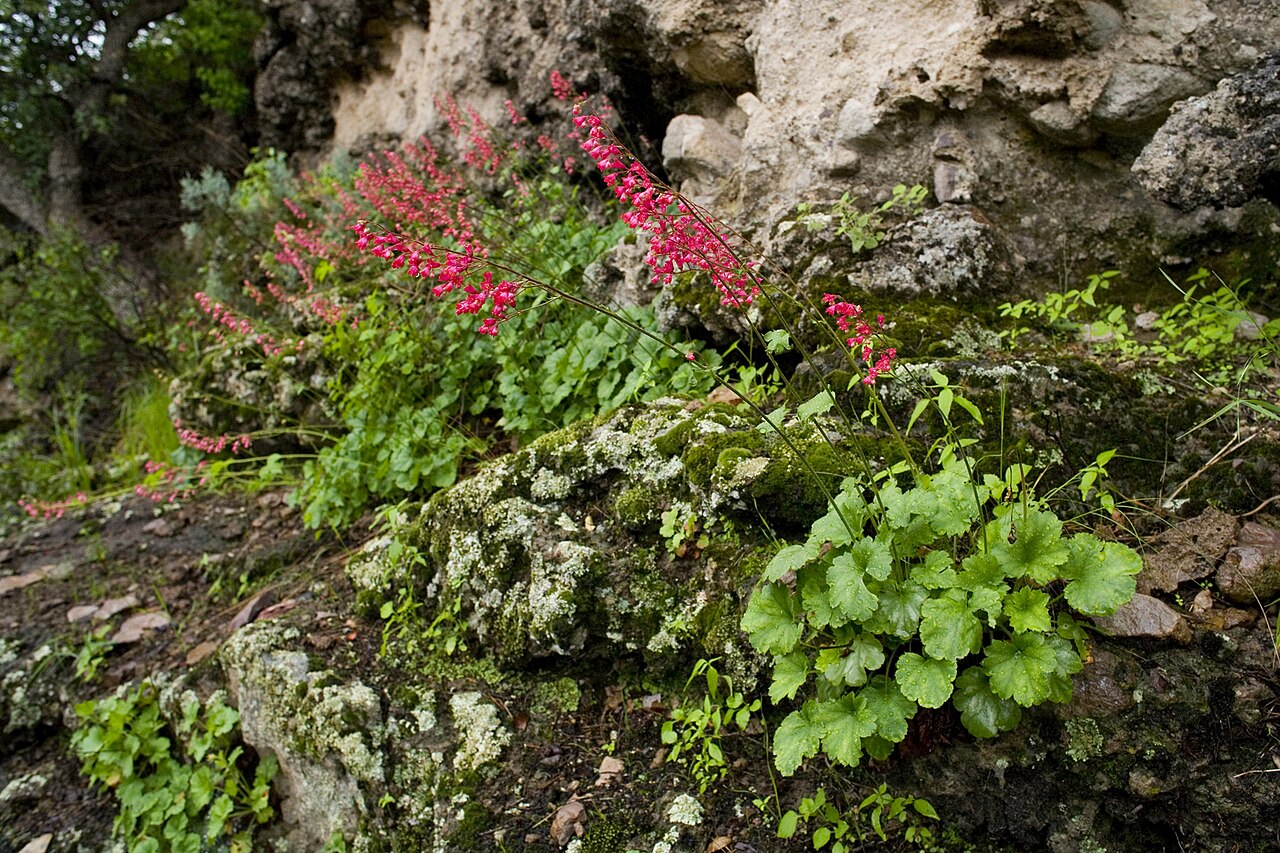
Coral bells are among the most familiar perennials at any garden center, but many people don’t realize the genus is entirely North American. Every wild Heuchera on Earth grows in the United States, Canada or Mexico, and most of them grow in the US, from Appalachian rock outcrops and Midwestern prairies to Rocky Mountain granite and the cliffs of California’s Channel Islands. The wild species usually go by the name alumroot, while “coral bells” originally meant the red-flowered Heuchera sanguinea of Arizona and New Mexico.
Native heucheras form low mounds of long-stalked, rounded, lobed leaves that stay green (or bronze, silver-marked or purple-tinged) for much of the year. In late spring or summer, depending on species, thin wiry stems rise well above the leaves and carry dozens of small bell-shaped flowers. Wild species range from the brilliant red of coral bells to pink, cream, white and pale green. They are easy, long-lived plants for part shade, rock gardens, woodland edges and the front of a border, and the flowers are visited by hummingbirds and small native bees.
This guide covers the native species gardeners are most likely to meet, where each one grows wild, how to tell them apart, and how they relate to the hundreds of colorful hybrid coral bells sold today. If you came from one of our Colorado or Wisconsin articles, the species native to your state are described below, along with tips for the winter frost-heaving that troubles coral bells in cold climates.
Identification
Heucheras are herbaceous perennials in the saxifrage family (Saxifragaceae). They grow from a thick, woody, often branching rootstock (caudex) that sits at or just above the soil surface. They have no true stem leaves to speak of; the foliage forms a basal rosette, and the flowering stalks are nearly leafless.
Leaves
The leaves are long-stalked, round to heart-shaped, and shallowly divided into five to nine lobes with toothed or scalloped edges, a bit like a small maple or geranium leaf. Size ranges from about 1 inch across in littleleaf alumroot to 6 inches or more in hairy alumroot and island alumroot. Many species have hairy leaf stalks, and some, especially American alumroot, show natural silver mottling or purple veining that breeders have exaggerated in garden selections. The foliage is evergreen or semi-evergreen in mild climates.
Flowers
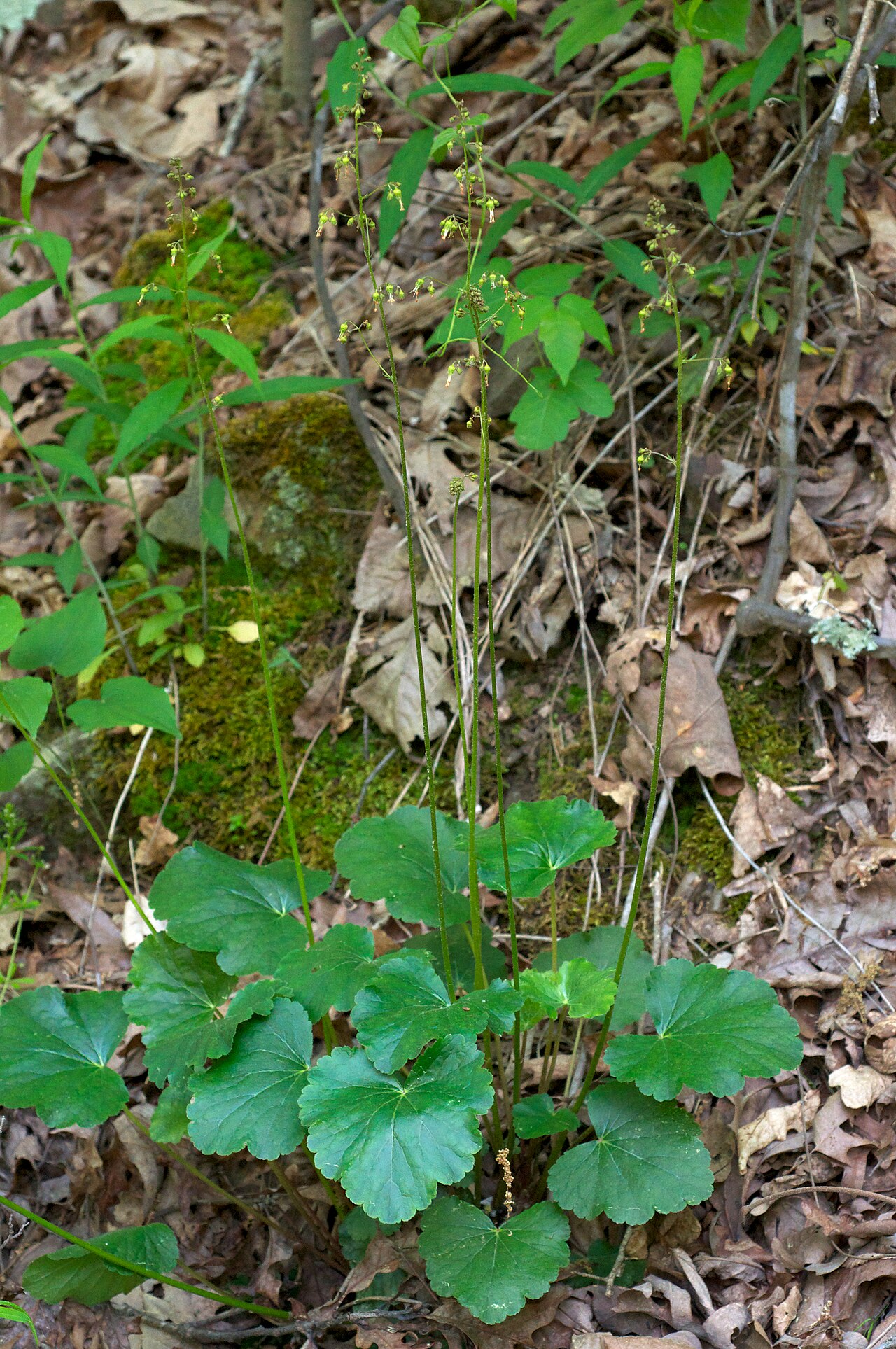
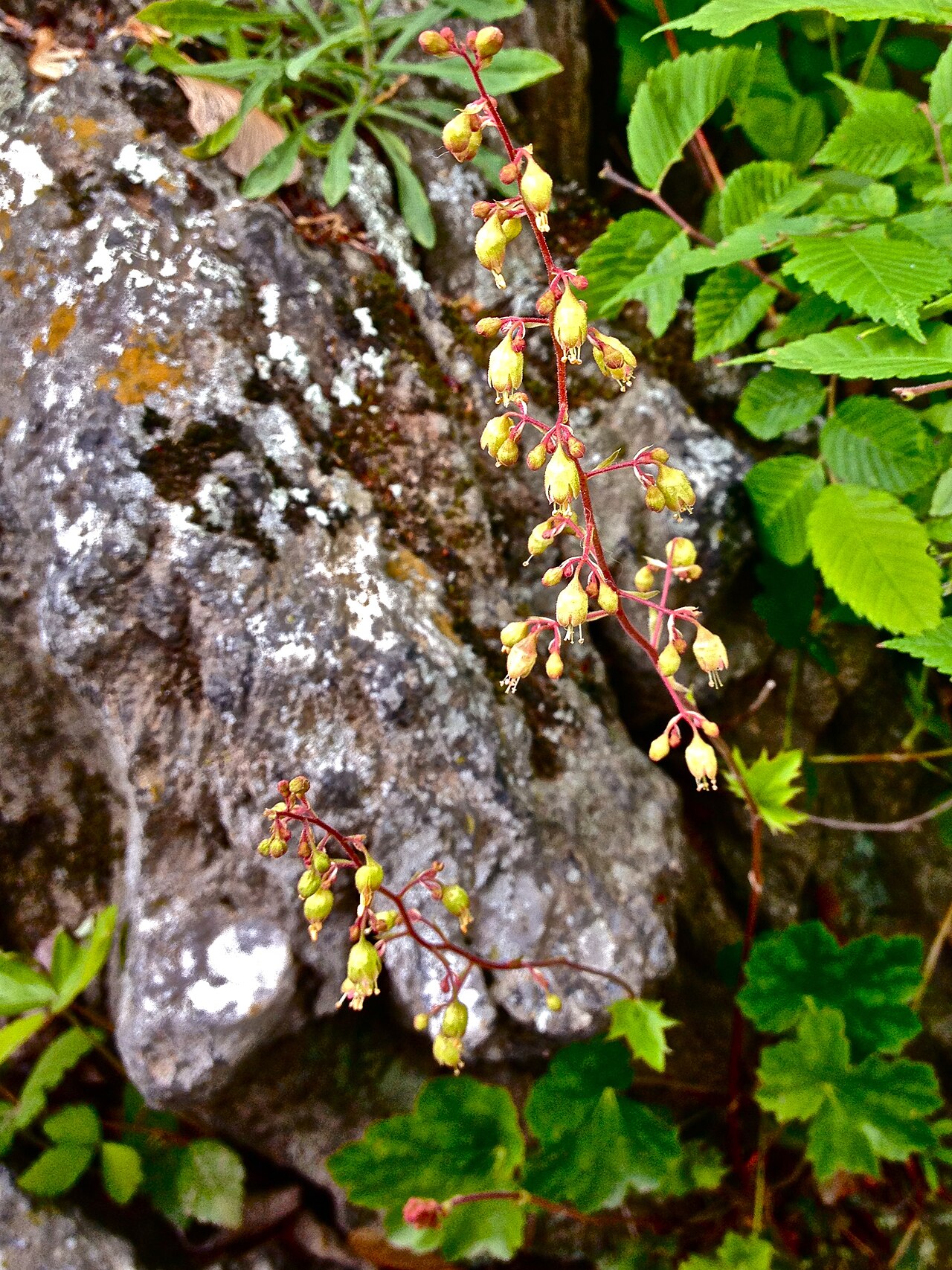
The flowers are small, usually ¼ inch long or less, and held in narrow, open or dense clusters (panicles) on stalks 1 to 3 feet tall. Each flower has a cup- or bell-shaped base (hypanthium), five small sepals and five tiny petals, plus five stamens. In many species the cup is the most colorful part, and in some the stamens stick out past the petals. Shape, color and how far the stamens protrude are the main features botanists use to separate species. Bloom time ranges from spring in the South and Southwest to late summer and fall in hairy alumroot.
Fruit & Seeds
Each flower ripens into a small, two-beaked capsule that splits open at the top and holds many tiny dark seeds. The seeds are dust-fine and need light to germinate, which is why seedlings appear mostly on bare, mossy rock or soil rather than in mulched beds.
Similar Native Plants
Several native relatives in the saxifrage family look like heucheras. Foamflower (Tiarella cordifolia) has similar leaves but a dense, bottlebrush-like spike of white, starry flowers with ten stamens. Bishop’s cap (Mitella diphylla) has tiny fringed, snowflake-like flowers and a pair of leaves on its flowering stem. In the West, fringe cups (Tellima grandiflora) carries larger, fringed flowers. Heucheras differ from all of these in having five stamens and small bells on a much-branched or wand-like stalk.
Quick Facts
| Scientific Name | Heuchera L. (genus) |
| Family | Saxifragaceae (Saxifrage) |
| US-Native Species | About 35 (approximate); the whole genus is native to North America |
| Growth Forms | Clump-forming evergreen or semi-evergreen perennials from a woody crown |
| Mature Height | Leaf mounds 4–12 in.; flower stalks about 1–3 ft, depending on species |
| Mature Spread | About 8–24 in. |
| Sun Exposure | Part Shade for most species; some tolerate Full Sun in cool or northern gardens |
| Water Needs | Moderate; well-drained soil that does not stay soggy; many species are drought tolerant once established |
| Soil Type | Well-drained loam, rocky or gravelly soil; many grow wild in rock crevices |
| Bloom Time | Spring to early summer for most; late summer to fall for hairy alumroot |
| Flower Color | Red, pink, cream, white or greenish, depending on species |
| Wildlife Value | Nectar for hummingbirds (red-flowered species) and small native bees |
| Deer Resistant | Moderately; deer and rabbits sometimes browse the leaves |
| USDA Hardiness Zones | Varies by species; roughly zones 3–9 |
Native Range
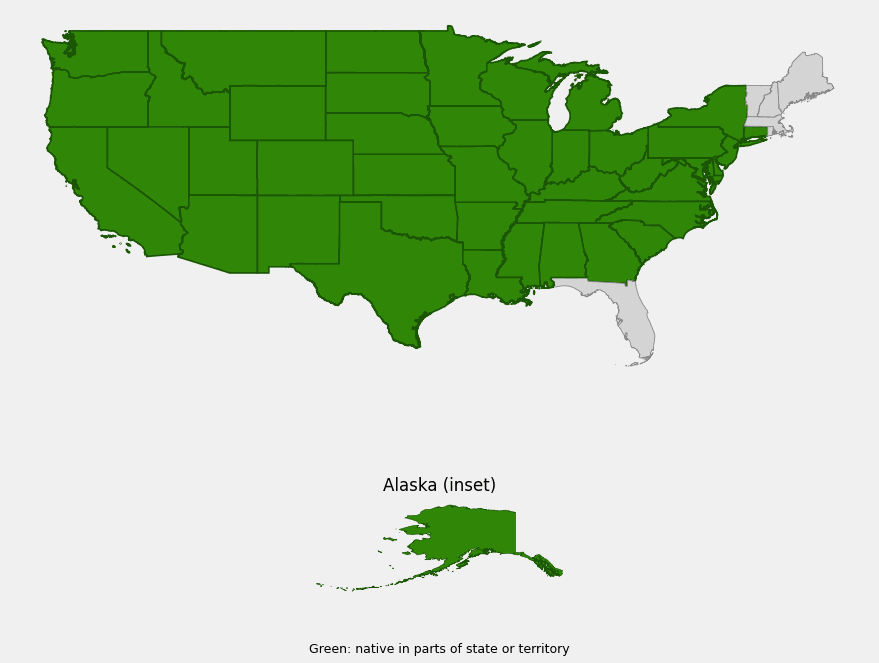
Heucheras are native to nearly every part of the United States. The greatest number of species grows in the West, where they occupy rock crevices, cliffs, talus slopes and moist canyons from the deserts’ sky islands to above timberline. California, Arizona, Colorado, Utah and the Pacific Northwest each have several species. In the East, alumroots grow on rocky woodland slopes, ledges and bluffs, with the most variety in the Appalachians and the Ozarks.
Prairie alumroot carries the genus across the Midwest and Great Plains, where it grows in dry prairies, sand savannas and open woods. American alumroot covers much of the eastern and central states, from Connecticut and New York south to Georgia and west to Michigan, Missouri, Oklahoma and east Texas. Alaska has its own species, alpine heuchera (H. glabra), along its southeastern coast and mountains.
There are a few gaps. No Heuchera is native to Florida, Maine, New Hampshire, Vermont, Massachusetts or Rhode Island; in New England, only Connecticut has a wild population (of American alumroot). None is native to Hawaii. Garden coral bells are planted in all of these places, but they are cultivated there, not native.
📋 Regional plant lists with native coral bells and alumroots: Connecticut, Massachusetts & Rhode Island · New York, Pennsylvania & Northern New Jersey · Delaware, Southern New Jersey & Long Island · Maryland, Virginia & West Virginia · North Carolina & South Carolina · Georgia, Alabama & Mississippi · Arkansas, Louisiana, Eastern Oklahoma & Eastern Texas · South & West Texas · Kentucky & Tennessee · Ohio & Indiana · Illinois, Iowa & Missouri · Michigan, Wisconsin & Eastern Minnesota · North Dakota, South Dakota & Western Minnesota · Nebraska, Kansas & Eastern Colorado · Montana & Wyoming · Utah & Western Colorado · Arizona & New Mexico · Idaho, Eastern Oregon & Eastern Washington · Western Oregon & Washington · California & Nevada · Alaska
Native Species
These are the native heucheras most important to gardeners and most likely to be seen in the wild, roughly from east to west. Species with a full growing guide on our site are linked.
American alumroot (Heuchera americana) is the common alumroot of eastern and central woodlands, native from Connecticut and New York south to Georgia and west to Michigan, Missouri, Oklahoma and east Texas. Its leaves are often mottled with silver or veined in purple, and its greenish or purple-tinged flowers open in late spring on 2- to 3-foot stalks. It is one of the main parents of modern colorful-leaved coral bells, and wild-type selections such as ‘Dale’s Strain’ and ‘Garnet’ remain good garden plants for dry shade.
Hairy alumroot (Heuchera villosa) grows on shaded rock outcrops and cliffs in the southern Appalachians and nearby uplands. It has large, fuzzy, sharply lobed leaves and airy sprays of tiny white to pinkish flowers in late summer and early fall, much later than other species. It handles heat and humidity better than most coral bells, so it is the best choice in the Southeast and a parent of many heat-tolerant hybrids.
Downy alumroot (Heuchera pubescens) is a central Appalachian species of rocky woods in Pennsylvania, Maryland, Virginia, West Virginia, Kentucky and North Carolina. It has some of the largest flowers in the genus, plump bells in pale green, cream or pinkish-purple in late spring.
Littleflower alumroot (Heuchera parviflora) grows on moist, shaded sandstone and limestone bluffs from the Appalachians to the Ozarks. Its soft, rounded leaves form flat rosettes on rock, and its tiny white flowers come in late summer.
Prairie alumroot (Heuchera richardsonii) is the heuchera of the Midwest and Great Plains, from Michigan and Indiana west to the Dakotas and Kansas and north into Canada. It grows in dry to mesic prairies, sand savannas and open, rocky woods, and its green flowers rise on 2- to 3-foot stalks in late spring and early summer. This is the native coral bells for Wisconsin, Minnesota and Iowa gardens, and it is one of the most cold-hardy species.
Littleleaf alumroot (Heuchera parvifolia) is the most widespread species of the Rocky Mountains, from Montana and Idaho south through Wyoming, Colorado and Utah to Arizona and New Mexico. It grows in rock crevices and gravelly slopes from the foothills to high elevations, with small leaves and dense, narrow clusters of creamy yellow flowers in summer. It is the alumroot most Colorado hikers will see.
Bracted alumroot (Heuchera bracteata) is a small, tough species of granite crevices in the Front Range of Colorado and nearby southern Wyoming. Its greenish flowers sit on one side of a short, bristly spike.
Hall’s alumroot (Heuchera hallii) is a compact Colorado endemic of granite outcrops along the Front Range, with small leaves and short stalks of white to pinkish bells. It suits rock gardens in Colorado.
Coral bells (Heuchera sanguinea) is native to moist, shaded rock ledges and canyons in the mountains of southern Arizona and southwestern New Mexico, and in northern Mexico. Its bright red to coral-pink bells, held on 12- to 20-inch stems in late spring and summer, are a hummingbird favorite, and it is the species behind the old-fashioned red coral bells of American gardens. It grows well in part shade with good drainage in much of the country.
Pink alumroot (Heuchera rubescens) grows in rock crevices across the Great Basin and the mountains of the interior West, including Utah, Nevada, eastern California and the mountains of west Texas. It has small, leathery leaves and pink-tinged white flowers and is very drought tolerant once established.
Roundleaf alumroot (Heuchera cylindrica) is a species of the northern Rockies and inland Northwest, including Idaho, Montana, eastern Oregon and Washington. Its cream to greenish flowers form a dense, cylindrical spike above rounded, scalloped leaves. It is a good choice for dry, rocky gardens in the Intermountain West.
Crevice alumroot (Heuchera micrantha) is the common heuchera of the Pacific Northwest and northern California, found on cliffs, banks and stream-side rocks in Washington, Oregon, Idaho and California. Clouds of tiny white flowers float on branched stalks above lobed leaves in late spring. It is another parent of many garden hybrids.
Island alumroot (Heuchera maxima) grows only on the northern Channel Islands of California, on sea cliffs and in canyons. It is the largest species, with leaves up to 6 inches across and big, branched panicles of white to pale pink flowers in late winter and spring. It is a dependable, drought-tolerant shade plant for coastal California gardens and a parent of the Rancho Santa Ana hybrids such as ‘Santa Ana Cardinal’.
Alpine heuchera (Heuchera glabra) grows on wet cliffs and rocky streamsides from southern Alaska through British Columbia to the Cascades of Washington and Oregon. It has glossy, sharply lobed leaves and loose sprays of small white flowers in summer.
Non-Native Look-Alikes
Because the entire genus is North American, there are no Eurasian heuchera species to watch out for. What you will find at nurseries are hybrids and a few unrelated look-alikes.
- Hybrid coral bells (Heuchera × brizoides and modern hybrids, sometimes labeled H. × hybrida): Most coral bells sold today are garden hybrids built from native species, chiefly American, hairy, crevice and red coral bells, with island alumroot in some West Coast lines. Selections such as ‘Palace Purple’, ‘Caramel’, ‘Obsidian’ and ‘Lime Rickey’ were bred for leaf color rather than flowers. They are not invasive and are a reasonable garden plant, but they are not the same as the wild species. Many have smaller, less useful flowers for pollinators and are shorter-lived than wild alumroots. If you want a true native, look for a species name with no cultivar, or a straight-species selection such as ‘Dale’s Strain’.
- Foamy bells (×Heucherella): A garden-made cross between Heuchera and foamflower (Tiarella). Both parents are North American, but ×Heucherella is a nursery hybrid, not a wild plant. It has foamflower’s lobed, often dark-patterned leaves and short spikes of small pink or white flowers.
- Bergenia (Bergenia species): Asian relatives in the same family, with large, glossy, paddle-shaped leaves and clusters of pink flowers in early spring. Bergenia leaves are much bigger and smoother than any heuchera.
- Strawberry begonia (Saxifraga stolonifera): An East Asian groundcover with round, silver-veined, hairy leaves that spreads by red runners like a strawberry. It occasionally escapes into shady, moist woods in the Southeast. Its white flowers have two long, drooping lower petals, unlike heuchera’s small bells.
Growing & Care Guide
Light
Most heucheras do best in part shade: morning sun with afternoon shade, or bright, dappled light under deciduous trees. In northern and cool mountain gardens, including much of Wisconsin and Colorado, many species and hybrids take full sun if the soil doesn’t dry out. In the South and hot interior valleys, give them afternoon shade. Hairy alumroot and American alumroot handle the most shade; red coral bells and the Rocky Mountain species want more light.
Soil & Water
Good drainage matters more than anything else. Heucheras grow wild in rock crevices and on slopes where water never stands, and the most common way to lose them is crown rot in heavy, wet clay. Plant in loam, gravelly soil or a raised bed, and add grit rather than lots of compost to clay. Water regularly the first summer; after that, most native species need watering only during long dry spells. The western rock species (littleleaf, pink, roundleaf and island alumroot) are quite drought tolerant.
Planting Tips
Set the crown so it sits right at the soil surface, not buried. Space plants about 12 to 18 inches apart for a groundcover effect. Spring or early fall planting gives roots time to anchor before winter, which matters in cold climates.
Pruning & Maintenance
Cut spent flower stalks back to the base to tidy the plant and, in some cases, encourage more leaves or a second flush of bloom. Pull off tattered old leaves in early spring. Heucheras are prone to frost heaving: in climates with repeated freeze-thaw cycles, like Wisconsin and Colorado, the shallow crowns can be pushed up out of the ground over winter. Check plants in early spring and press heaved crowns back into the soil, and put down a light mulch after the ground freezes to reduce heaving. After three or four years the crowns grow woody and leggy and rise above the soil; lift, divide and replant them deeper so the leafy rosette sits at soil level.
Propagation
Divide established clumps in spring or early fall, making sure each piece has some roots and a leafy crown. Wild species also grow easily from seed: scatter the tiny seed on the surface of a moist, fine seed mix, do not cover it (it needs light), and keep it moist. Hybrids do not come true from seed.
Landscape Uses
- Shade and woodland gardens, with foamflower, wild ginger and Christmas fern
- Rock gardens and stone walls, where the crowns stay dry and the flower stalks arch over the stone
- Groundcover under trees, massed with Pennsylvania sedge
- Hummingbird gardens, using red coral bells with wild columbine or, in the West, Colorado blue columbine and scarlet bugler
- Front of the border and containers, for long-season foliage
- Spring woodland combinations with woodland phlox, wild geranium and Virginia bluebells
Wildlife & Ecological Value
For Pollinators
Heuchera flowers produce nectar and pollen for small native bees, including sweat bees and small carpenter and mason bees, as well as bumblebees and flower flies. The red, tubular-bell flowers of coral bells are adapted to hummingbirds, and hummingbirds also visit pink-flowered species and hybrids.
For Birds
Hummingbirds are the main bird visitors. The tiny seeds are too small to be an important bird food.
For Mammals
Deer and rabbits browse heucheras occasionally but usually prefer other plants, so they are considered moderately deer resistant.
Ecosystem Role
In the wild, heucheras are pioneers of rock faces, ledges and thin soils where few other plants can root. Their evergreen rosettes help hold soil and moss on steep slopes and provide winter cover for small invertebrates on the forest floor.
Cultural & Historical Uses
The common name alumroot refers to the strongly astringent roots, which reminded early settlers of alum. Several Native American peoples used the roots of various species as an astringent, for example on wounds and sores, and some western tribes used them as a dye mordant. These are historical uses, not recommendations.
The genus was named by Linnaeus for Johann Heinrich von Heucher, an 18th-century German physician and botanist. Red coral bells from the Southwest reached European gardens in the late 1800s, and French and English nurseries soon crossed it with other species to create the first hybrid coral bells, Heuchera × brizoides.
The modern boom in colorful heucheras began in the 1980s and 1990s, when breeders in the US and Europe started selecting purple, silver and amber leaf forms from American alumroot, hairy alumroot and crevice alumroot. Today there are hundreds of named cultivars, all ultimately descended from North American wildflowers.
Frequently Asked Questions
Are coral bells native to the United States?
Yes. The genus Heuchera is native only to North America, and about 35 species grow wild in the US. Many coral bells sold in stores, though, are hybrids bred for leaf color rather than wild species. For a true native, look for a plant labeled with a species name such as Heuchera americana, H. richardsonii or H. sanguinea.
Which coral bells are native to Colorado?
Littleleaf alumroot (Heuchera parvifolia) is the most widespread, and bracted alumroot (H. bracteata) and Hall’s alumroot (H. hallii) grow in the granite of the Front Range. All three like rocky, well-drained soil and part sun. Red coral bells (H. sanguinea), native just to the south in Arizona and New Mexico, also grows well in Colorado gardens.
Which coral bells are native to Wisconsin?
Prairie alumroot (Heuchera richardsonii) is the native species across most of Wisconsin and the upper Midwest. It grows in sun or part shade in well-drained soil and is very winter hardy.
Why do my coral bells pop out of the ground in spring?
That’s frost heaving. Freezing and thawing pushes the shallow crowns up, exposing the roots. Press them back down or replant them as soon as the soil can be worked, mulch lightly after the ground freezes, and replant older, woody crowns a little deeper.
Do coral bells attract hummingbirds?
Red- and pink-flowered heucheras, especially red coral bells (Heuchera sanguinea) and its hybrids, are visited by hummingbirds. White- and green-flowered species are visited mostly by small bees.

Looking for a nursery that carries Native Coral Bells?
Browse our native plant nursery directory: Alabama, Alaska, Arizona & Arkansas · California · Colorado, Connecticut, Delaware & Georgia · Idaho, Illinois, Indiana, Iowa & Kansas · Kentucky, Louisiana, Maryland, Michigan, Minnesota, Mississippi, Missouri & Montana · Nebraska, Nevada, New Jersey, New Mexico, New York, North Carolina, North Dakota, Ohio & Oklahoma · Oregon · Pennsylvania, South Carolina, South Dakota, Tennessee, Texas, Utah & Virginia · Washington · West Virginia, Wisconsin & Wyoming

