
Native Penstemons (Penstemon)
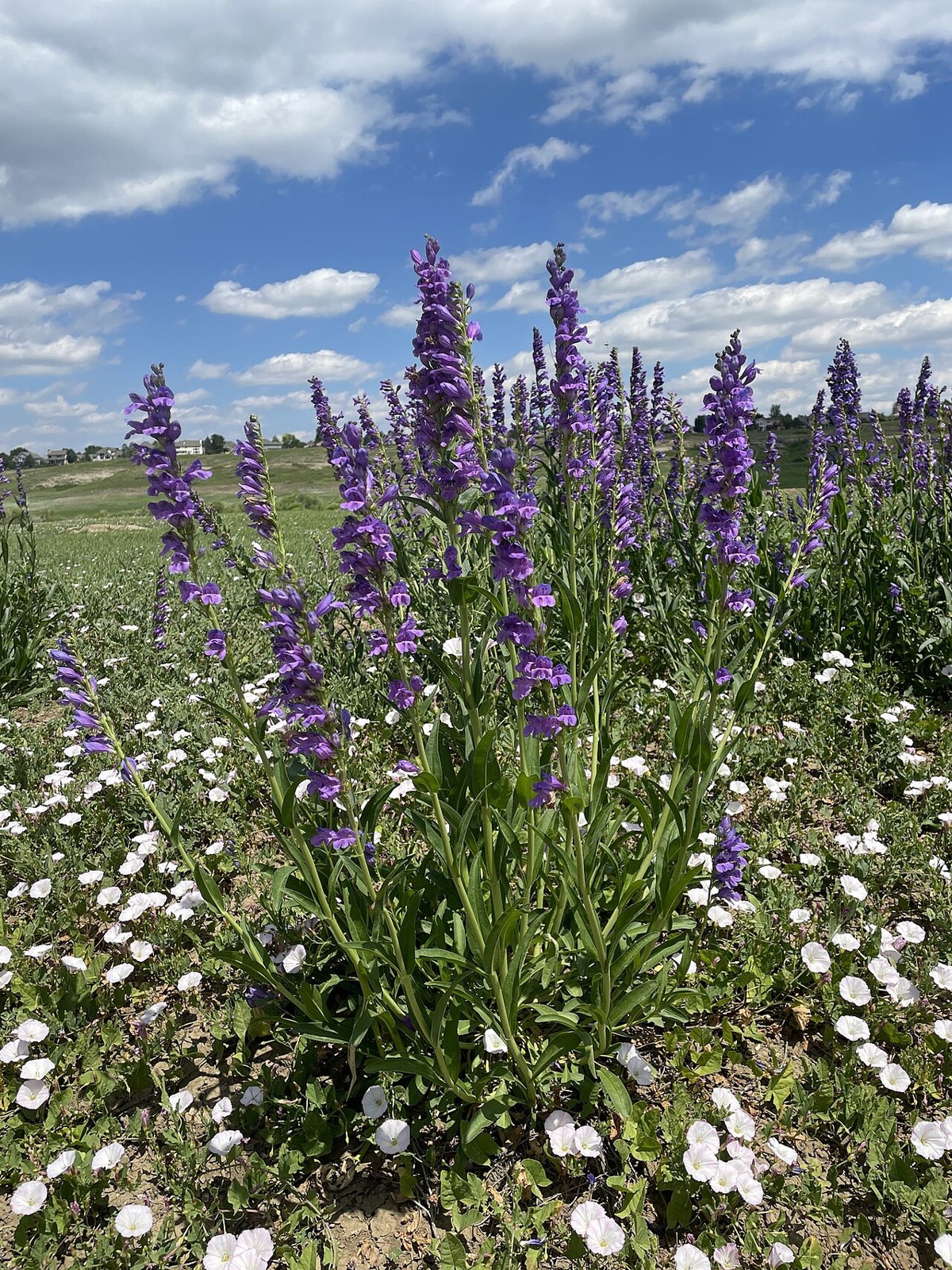
Penstemons, also called beardtongues, are North America’s signature wildflower genus. Nearly every one of the roughly 250 species is native to this continent, and native species grow wild in Alaska and in every contiguous state except, as far as the records show, New Hampshire, from Florida sandhills and Michigan prairies to Utah canyon country, California chaparral and alpine rock above treeline. Their tubular, two-lipped flowers come in blue, violet, pink, scarlet, white and even yellow, and they are some of the best plants you can grow for native bees and hummingbirds.
The name “beardtongue” refers to the fifth stamen. Penstemon flowers have four fertile stamens plus a sterile one, the staminode, that often lies along the floor of the flower tube and in many species is covered in yellow or golden hairs, like a bearded tongue. The scientific name, from Greek, is usually explained as “almost a stamen,” a nod to the same structure.
The West is the heart of the genus. Utah, Nevada, Colorado, Arizona and California each have dozens of species, many of them found nowhere else, while the East and Midwest have a smaller but garden-worthy set such as foxglove beardtongue, hairy beardtongue and pale beardtongue. Garden centers also sell hybrid penstemons such as the Dakota, Mexicali and Pinacolada series. This guide covers the US-native species, how to tell them apart from look-alikes and hybrids, and how to grow them.
Identification
Penstemons are mostly herbaceous perennials, with some woody-based subshrubs and low, mat-forming alpine species. Most grow from a basal rosette of leaves and send up one or more upright flowering stems in late spring or summer.
Leaves & Stems
Leaves are opposite (in pairs) along the stem, and the upper pairs are often stalkless and clasp the stem. Many western desert species have thick, smooth, blue-gray leaves coated in a waxy bloom; Rocky Mountain and foxglove beardtongue have glossy green leaves; pine-leaf penstemon has needle-like leaves; and large-flowered penstemon has broad, rounded, gray-green leaves that almost wrap the stem. Stems are often slender and wand-like, and some species, such as foxglove beardtongue cultivars, turn purplish.
Flowers
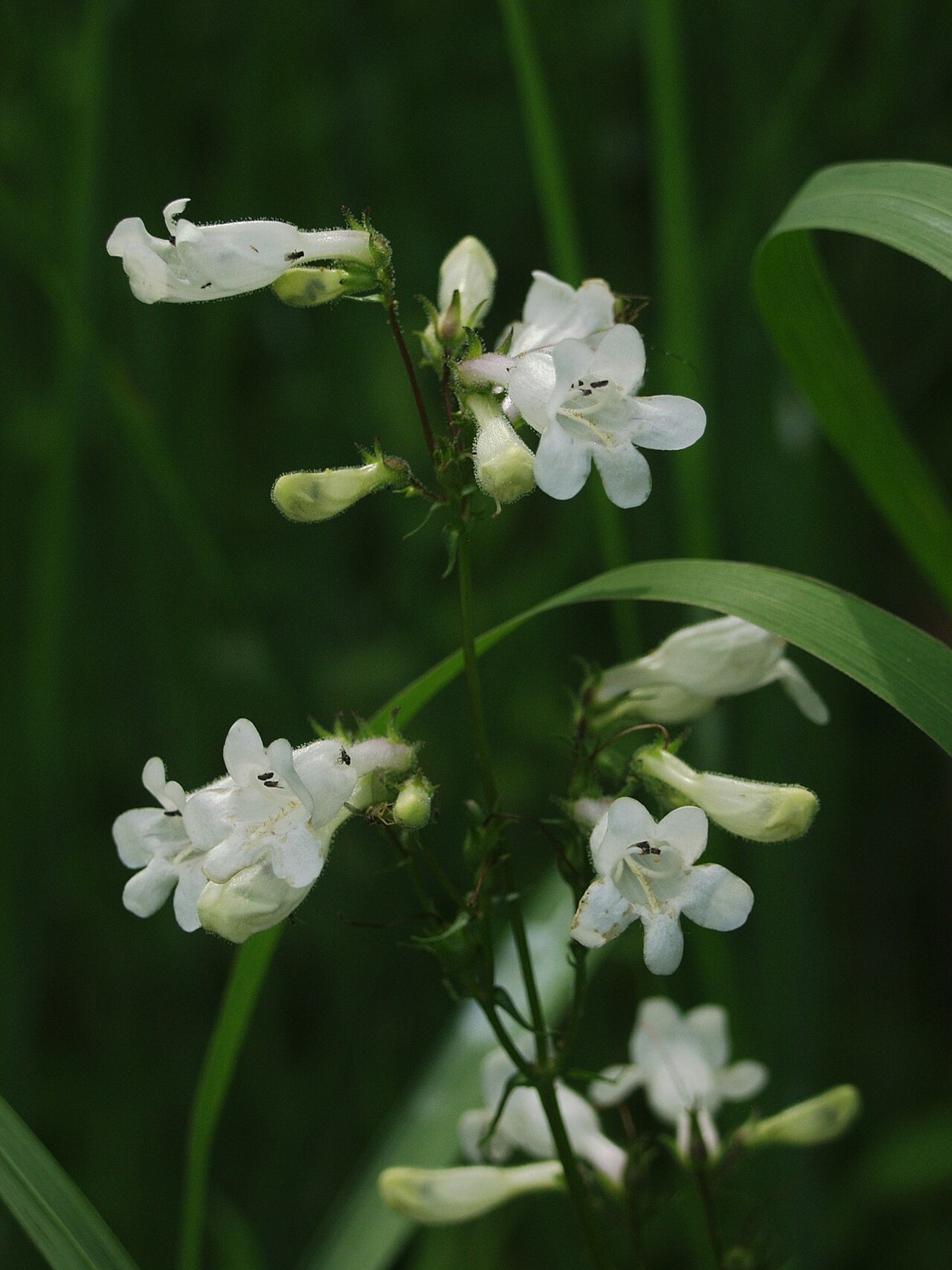
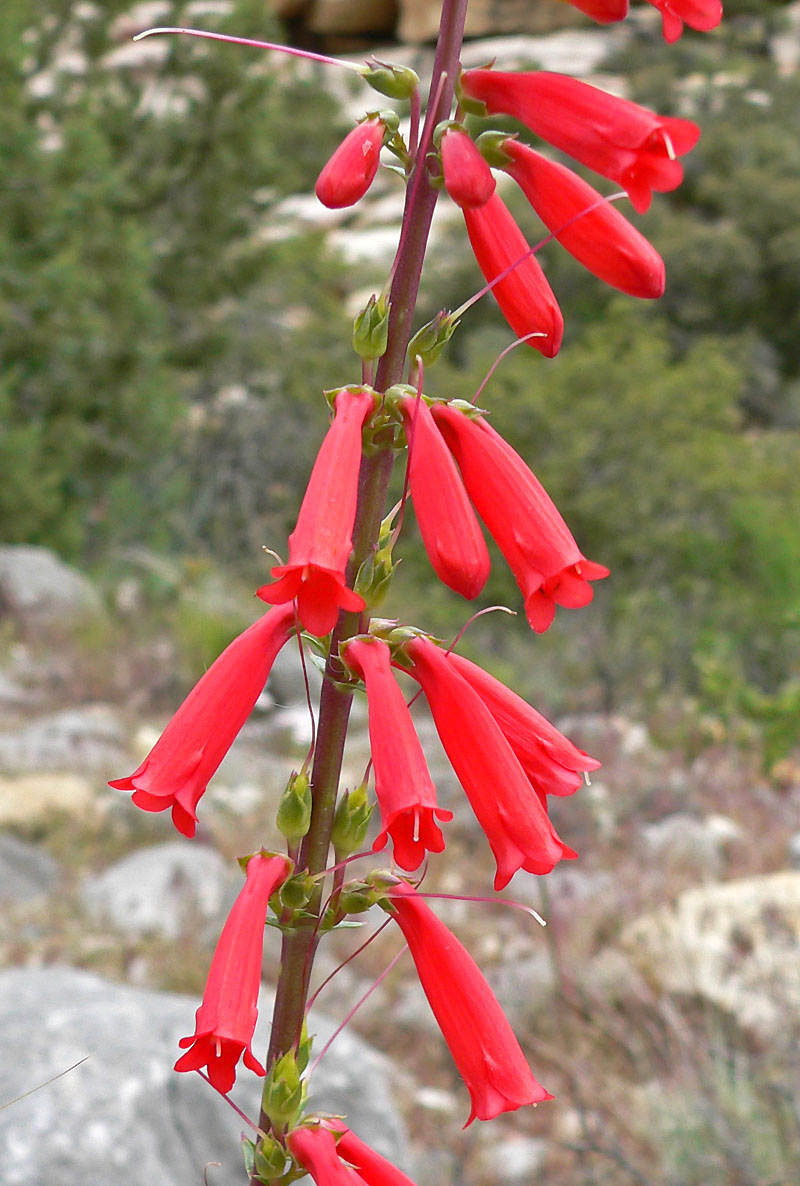
The flowers are tubular to bell-shaped, with two upper lobes and three lower lobes, held in spikes or loose clusters, often all turned to one side of the stem. The staminode (the “beard”) is a useful identification clue: it may be densely bearded, sparsely hairy or smooth, and it can be visible at the mouth of the flower or hidden inside. Red, narrow-tubed flowers (firecracker penstemon, scarlet bugler, Bridges’ penstemon) are adapted to hummingbirds; wide-mouthed blue, purple, pink and white flowers are adapted to bees.
Fruit & Seeds
The fruit is a hard, pointed capsule that splits open in late summer or fall to release many small, angular seeds. Dried stalks with their capsules stay upright into winter and are a handy way to recognize penstemon patches after bloom.
Quick Facts
| Scientific Name | Penstemon Schmidel (genus) |
| Family | Plantaginaceae (Plantain family; formerly placed in Scrophulariaceae) |
| US-Native Species | Roughly 250 in the genus; well over 200 native to the US (approximate) |
| Growth Forms | Herbaceous perennials, woody-based subshrubs and low alpine mats |
| Mature Height | A few inches (alpine mats) to about 6 ft; most 1–3 ft |
| Mature Spread | About 6 in to 2 ft |
| Sun Exposure | Full sun for most; a few eastern species take part shade |
| Water Needs | Low for most western species; moderate for eastern and prairie species |
| Soil Type | Well-drained sandy, gravelly or rocky soil; foxglove beardtongue tolerates clay and moist soil |
| Soil pH | Mostly neutral to alkaline; eastern species tolerate slightly acidic soil |
| Bloom Time | March – September depending on species, mostly late spring to early summer |
| Flower Color | Blue, violet, lavender, pink, magenta, scarlet, white; rarely pale yellow |
| Wildlife Value | Native bees (including penstemon specialist bees), hummingbirds, butterflies and moths |
| Deer Resistant | Moderately; deer avoid many species but will browse some |
| USDA Hardiness Zones | About 3–10 across the genus, varying by species |
Native Range
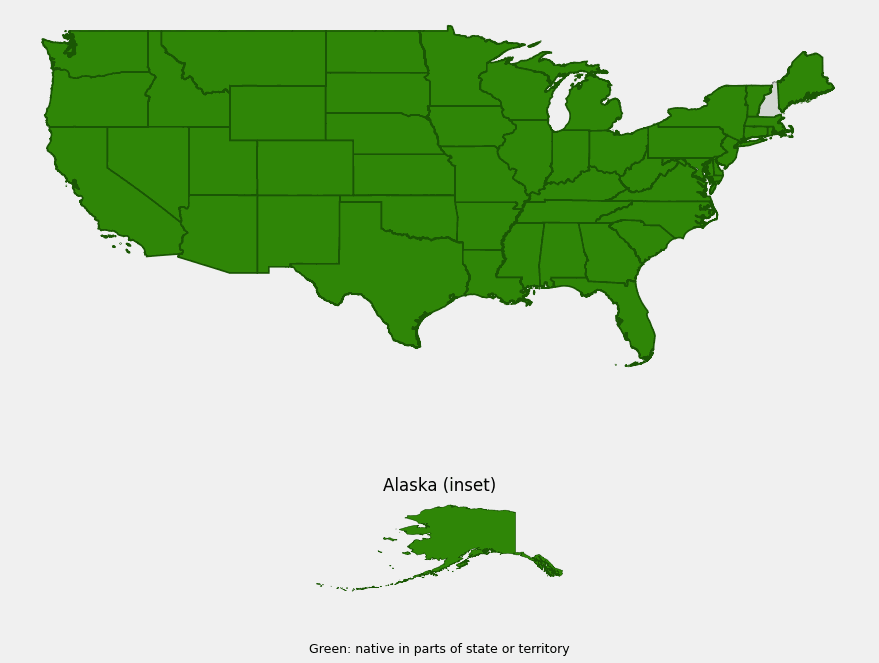
Native penstemons grow in Alaska and in 47 of the 48 contiguous states; Hawaii has none. New Hampshire is the odd one out: botanists there treat its foxglove and pale beardtongue populations as of uncertain origin, and hairy beardtongue, native in the rest of New England, has never been confirmed in the state. The number of species climbs dramatically from east to west. Most eastern states have only a handful, typically foxglove beardtongue, hairy beardtongue, pale beardtongue, eastern smooth beardtongue and, in the Southeast, species such as Eustis Lake and manyflower beardtongue. The Great Plains add large-flowered, pagoda, white-flower and cobaea beardtongues.
West of the Rockies the genus explodes. Utah is one of the richest states in the country for penstemons, with dozens of species ranging from scarlet firecracker penstemon in the red-rock country to Wasatch penstemon and Rocky Mountain penstemon in the mountains, and a number of rare species restricted to particular soils. Colorado, Nevada, Arizona, New Mexico, California, Idaho and Oregon are also rich in species. In Alaska a few species reach the far north, including Gorman’s penstemon in the interior.
In Michigan and Wisconsin, the native penstemons are prairie, savanna, bluff and meadow plants: foxglove beardtongue, hairy beardtongue, slender beardtongue (P. gracilis, common on Wisconsin prairies and rare in Michigan) and, in western Wisconsin sand prairies, large-flowered penstemon. Foxglove beardtongue, pale beardtongue and large-flowered penstemon are widely planted, so some populations at the edges of their ranges, particularly in New England, are escapes rather than native stands. Large-flowered penstemon is not native in New England at all.
📋 Regional plant lists with native penstemons: Utah & Western Colorado · Michigan, Wisconsin & Eastern Minnesota · Arizona & New Mexico · California & Nevada · Idaho, Eastern Oregon & Eastern Washington · Western Oregon & Western Washington · Montana & Wyoming · Nebraska, Kansas & Eastern Colorado · North Dakota, South Dakota & Western Minnesota · South & West Texas · Arkansas, Louisiana, Eastern Oklahoma & Eastern Texas · Illinois, Iowa & Missouri · Ohio & Indiana · Kentucky & Tennessee · New York, Pennsylvania & Northern New Jersey · Delaware, Southern New Jersey & Long Island · Maryland, Virginia & West Virginia · North & South Carolina · Georgia, Alabama & Mississippi · Connecticut, Massachusetts & Rhode Island · New Hampshire, Maine & Vermont · Alaska
Native Species
With well over 200 US species, no single page can cover them all. These 15 are the penstemons gardeners are most likely to meet or grow, grouped by region, and each links to our full profile. Every other penstemon profile on the site is listed at the end of this section.
Eastern & Midwestern Penstemons
Foxglove beardtongue (Penstemon digitalis) is the most widely grown eastern species: 2 to 4 feet tall with glossy leaves and airy spikes of white, sometimes faintly lavender-tinged flowers in late spring. It is native from the Great Plains east to the Atlantic states, including Michigan and Wisconsin, and tolerates clay and moist soil better than most penstemons. ‘Husker Red’ is its well-known purple-leaved selection.
Hairy beardtongue (Penstemon hirsutus) is a shorter, 1- to 2-foot plant of rocky woods, bluffs and dry meadows in the Northeast and Great Lakes states. Its pale lavender flowers have a nearly closed throat and a densely bearded staminode, which pokes out of the mouth like a fuzzy tongue.
Eastern smooth beardtongue (Penstemon laevigatus) resembles a smaller foxglove beardtongue, with white to pale lavender flowers, and grows in moist woods and meadows from Pennsylvania and New Jersey south to Florida and west to Mississippi.
Great Plains Penstemons
Large-flowered penstemon (Penstemon grandiflorus) has the biggest flowers of the eastern species: inflated, 2-inch lavender-pink bells above rounded, blue-gray leaves that clasp the stem. It is a short-lived perennial of sandy prairies in the Great Plains and upper Midwest, including western Wisconsin.
Cobaea beardtongue (Penstemon cobaea) of the southern plains, from Nebraska to Texas, has similarly large, inflated, pale lavender to purple flowers with purple guidelines inside the throat.
Pagoda penstemon (Penstemon angustifolius) carries tiers of sky-blue flowers on blue-gray stems on sandy prairies and sandhills of the High Plains.
Rocky Mountain & Intermountain Penstemons
Rocky Mountain penstemon (Penstemon strictus) is one of the best penstemons for gardens: tough, longer-lived than most and covered in deep blue-purple flowers in early summer. It is native to Utah, Colorado, Wyoming, New Mexico and Arizona.
Firecracker penstemon (Penstemon eatonii) is the classic Utah hummingbird plant, with scarlet tubes on arching stems in spring, one of the earliest penstemons to bloom.
Scarlet bugler or beardlip penstemon (Penstemon barbatus) carries red flowers with a bearded, down-curved lower lip on tall stems into midsummer, from Utah and Colorado south to Arizona, New Mexico and west Texas.
Palmer penstemon (Penstemon palmeri) is unusual for its large, inflated, fragrant pale pink flowers on stems up to about 6 feet, above thick, toothed, blue-gray leaves.
Wasatch penstemon (Penstemon cyananthus) brings bright blue whorls of flowers to the Wasatch Front and nearby mountains of Utah, Idaho and Wyoming.
Showy penstemon (Penstemon speciosus) lights up sagebrush slopes of the Great Basin and interior Northwest with clear blue flowers.
Shrubby penstemon (Penstemon fruticosus) of the northern Rockies and Cascades forms woody mounds smothered in large lavender flowers in late spring.
Southwestern & California Penstemons
Pine-leaf penstemon (Penstemon pinifolius) of Arizona and New Mexico has needle-like leaves and orange-red flowers on a low, evergreen mound, perfect for rock gardens.
Foothill penstemon (Penstemon heterophyllus) is a California endemic of grassy slopes and chaparral openings with blue, violet and pink-tinged flowers, and a reliable choice for water-wise California gardens.
More penstemon profiles: Eustis Lake beardtongue (P. australis) · manyflower beardtongue (P. multiflorus) · white-flower beardtongue (P. albidus) · Hill Country penstemon (P. triflorus) · rock penstemon (P. baccharifolius) · Big Bend penstemon (P. havardii) · sidebells penstemon (P. secundiflorus) · Front Range beardtongue (P. virens) · Whipple’s penstemon (P. whippleanus) · dark blue penstemon (P. cyaneus) · Rydberg’s penstemon (P. rydbergii) · hot rock penstemon (P. deustus) · Bridges’ penstemon (P. rostriflorus) · lovely penstemon (P. venustus) · Davidson’s penstemon (P. davidsonii) · desert beardtongue (P. pseudospectabilis) · showy penstemon (P. spectabilis) · scarlet bugler (P. centranthifolius) · Cleveland’s penstemon (P. clevelandii) · Grinnell’s beardtongue (P. grinnellii) · mountain pride (P. newberryi)
Non-Native Look-Alikes
Because the genus is almost entirely North American, there are no invasive penstemons to worry about. The look-alikes gardeners need to sort out are hybrids, cultivars and unrelated plants with similar flowers.
Hybrid penstemon series. Garden centers sell many penstemons that are hybrids bred for nursery sales rather than wild species. The DAKOTA™ series (including Dakota Burgundy, with dark purple-black foliage and lavender flowers), the Mexicali series and the Pinacolada series are examples, along with the large-flowered “border penstemons” popular in Europe, many of which descend from Mexican species. These hybrids still offer nectar to bees and hummingbirds, but they are not wild native plants, and some are less cold-hardy or shorter-lived than the native species. If you want a true native, look for a species name such as Penstemon digitalis or Penstemon strictus on the label, ideally from a local-source native nursery. Selections of native species, such as foxglove beardtongue ‘Husker Red’, sit in between: they are a single native species, chosen for a particular trait.
Foxglove (Digitalis purpurea). European foxglove has similar tubular flowers on tall spikes but much larger, spotted, nodding bells and big, soft, hairy basal leaves. It is highly poisonous and has escaped and naturalized in parts of the Pacific Northwest and the Northeast. Foxglove beardtongue got its name from the resemblance. Both genera are now placed in the plantain family, but penstemons are not known for the dangerous heart toxins that make foxglove so poisonous.
Snapdragons and turtleheads. Garden snapdragons (Antirrhinum, from the Mediterranean) have closed, “snapping” flowers rather than open tubes. Native turtleheads (Chelone) have hooded, closed flowers in tight clusters and grow in wet ground. Woodland beardtongue (Nothochelone nemorosa) of the Pacific Northwest was once included in Penstemon and still looks very much like one.
Growing & Care Guide
Light
Almost all penstemons want full sun, and western species in particular flop, sulk or rot in shade. Foxglove beardtongue, hairy beardtongue and a few woodland-edge species tolerate part shade.
Soil & Water
Drainage is the single most important factor. Western penstemons evolved in gravel, sand and rock and are often killed by rich, moist garden soil, overwatering or winter wet around the crown. Plant them in lean, gritty soil, on slopes, berms or in rock gardens, and mulch with gravel instead of bark. Once established they need little or no supplemental water in most of the West. Eastern and prairie species are more forgiving: foxglove beardtongue handles clay and average garden moisture, and large-flowered penstemon wants sandy, dry soil. Skip fertilizer; it shortens their lives and makes them floppy.
Planting Tips
Choose a species native to your region; a Utah desert penstemon will struggle in a Michigan clay bed, and vice versa. Plant in spring or early fall, set the crown at or slightly above soil level, and water regularly only for the first season. Many western species are short-lived (three to five years), but they reseed readily in gravelly ground if you let the seed ripen.
Pruning & Maintenance
Cut flowering stalks after bloom if you want a tidier plant, or leave some to ripen seed and feed birds. Leave the basal rosette in place over winter; many species are evergreen at ground level. Remove leaves and mulch that pile up on the crowns.
Propagation
Most penstemons grow easily from seed. Many western species need a period of cold, moist conditions before they will germinate, so sow them outdoors in fall or give them several weeks of cold stratification in the refrigerator. Eastern species like foxglove beardtongue often germinate with a shorter cold period. Clumps can be divided in spring, and many species root from summer cuttings.
Landscape Uses
- Pollinator and hummingbird gardens
- Xeriscapes, rock gardens, gravel gardens and hell strips in the West
- Prairie and meadow plantings in the Midwest and East
- Sunny, well-drained borders and slopes
- Cut flowers (foxglove beardtongue and Rocky Mountain penstemon)
Wildlife & Ecological Value
For Pollinators
Penstemons are outstanding bee plants. Bumble bees, mason bees and many other native bees work their open-mouthed flowers, and in the West several native mason bees (Osmia) and pollen wasps (Pseudomasaris) specialize on penstemon pollen. Butterflies and sphinx moths also visit.
Birds
Red, narrow-tubed species, including firecracker penstemon, scarlet bugler, Bridges’ penstemon and pine-leaf penstemon, are classic hummingbird flowers in the West, timed to feed migrating and nesting hummingbirds. Seed-eating birds pick at the ripe capsules in fall and winter.
Mammals
Deer and rabbits browse penstemons in some areas, especially young plants, though many western gardeners find them less browsed than other perennials. Small rodents eat the seeds.
Ecosystem Role
Penstemons are among the first plants to colonize disturbed, gravelly ground such as road cuts and burns, and several are standard species in western restoration seed mixes. Many rare penstemons are restricted to specific soils, and a number are protected under state or federal law, so never dig plants from the wild.
Cultural & Historical Uses
Several Native American peoples used penstemons, mostly as poultices and washes for wounds, sores and toothache, and as a source of dye. These uses are recorded as history and are not recommendations.
Penstemons became popular garden plants in Europe in the 19th century, where breeders crossed Mexican and western American species to produce the large-flowered border penstemons still sold today. In North America, interest grew in the 20th century, and the American Penstemon Society, founded in 1946, has promoted growing and conserving the native species ever since.
Today penstemons are a mainstay of western water-wise landscaping. Native seed companies and restoration programs in Utah, Colorado, Idaho and Nevada grow large quantities of penstemon seed for roadsides, burned rangeland and pollinator habitat.
Frequently Asked Questions
Are penstemons native to Michigan and Wisconsin?
Yes. Foxglove beardtongue and hairy beardtongue are native in both states, slender beardtongue grows on Wisconsin prairies, and large-flowered penstemon grows in sand prairies of western Wisconsin and Minnesota. They are prairie and meadow plants that want sun and good drainage.
Which penstemons are best for Utah gardens?
Firecracker penstemon, Rocky Mountain penstemon, Palmer penstemon, Wasatch penstemon and scarlet bugler are reliable, widely available Utah natives. Give them full sun, gravelly soil and very little water once established.
Is DAKOTA™ Burgundy penstemon a native plant?
No. It’s a patented hybrid bred for gardens. It can still feed bees and hummingbirds, but if you want a wild native species, choose one native to your region, such as foxglove beardtongue in the East or Rocky Mountain penstemon in the West.
Why do my penstemons die after a few years?
Most often from too much water, rich soil or wet winter crowns. Many western penstemons are naturally short-lived; plant them in lean, well-drained soil and let some seed ripen so seedlings replace older plants.
Are penstemons deer resistant?
Moderately. Deer tend to avoid many penstemons, but they will browse some, especially young plants and fresh spring growth.

Looking for a nursery that carries Native Penstemons?
Browse our native plant nursery directory: Alabama, Alaska, Arizona & Arkansas · California · Colorado, Connecticut, Delaware, Florida & Georgia · Idaho, Illinois, Indiana, Iowa & Kansas · Kentucky, Louisiana, Maine, Maryland, Massachusetts, Michigan, Minnesota, Mississippi, Missouri & Montana · Nebraska, Nevada, New Jersey, New Mexico, New York, North Carolina, North Dakota, Ohio & Oklahoma · Oregon · Pennsylvania, Rhode Island, South Carolina, South Dakota, Tennessee, Texas, Utah, Vermont & Virginia · Washington · West Virginia, Wisconsin & Wyoming

